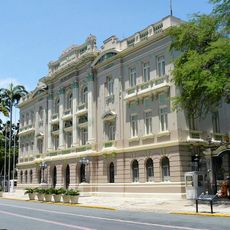
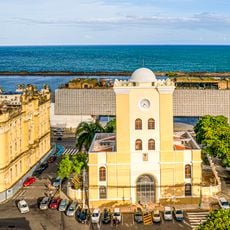
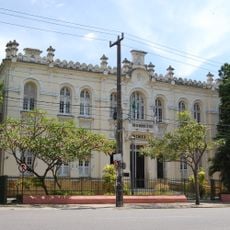
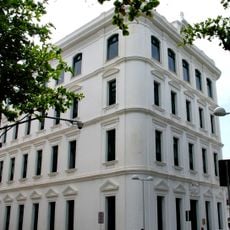
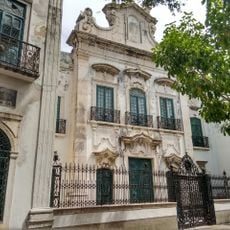
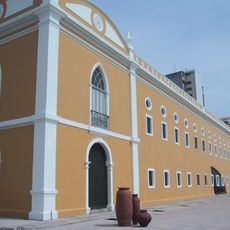
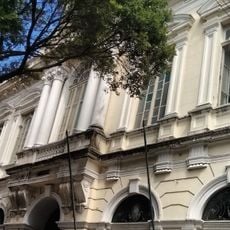
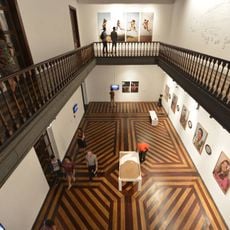
Palácio da Justiça, Eclectic courthouse in Santo Antônio, Brazil.
Palácio da Justiça is the courthouse of the Tribunal de Justiça de Pernambuco, designed by Italian architect Giácomo Palumbo in eclectic style and completed in 1930 on Praça da República. Its dome rises 45 metres, the highest in Brazil, and holds stained glass by Heinrich Moser, paintings by Murillo La Greca and sculptures by Bibiano Silva.
The cornerstone was laid on 2 July 1924 by governor and federal judge Sérgio Loreto, during the centennial of the Confederation of the Equator, and the building was completed on 7 September 1930. The site had earlier held Maurits of Nassau's Palácio de Friburgo, finished in 1642, later a barracks and demolished between 1774 and 1787; the Erário Régio replaced it and was itself demolished in 1840.
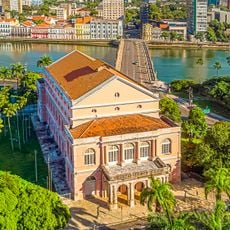
The stained glass is by Heinrich Moser, and the paintings inside are by Murillo La Greca; the building also has sculptures by Bibiano Silva. The courthouse keeps its role as seat of the Tribunal de Justiça de Pernambuco, and the eclectic design by Italian architect Giácomo Palumbo places it beside the Teatro de Santa Isabel and the Palácio do Campo das Princesas on the Praça da República.
The building is open to visitors on most weekdays with security checks at the entrance. It is advisable to arrive during business hours and check ahead as court sessions may occasionally restrict access to certain areas.
The dome of the Palácio da Justiça rises 45 metres, the highest in Brazil. Its stained glass was made by Heinrich Moser, the paintings are by Murillo La Greca and the sculptures by Bibiano Silva. The building stands on the site of earlier palaces: the Friburgo palace of Count Maurice of Nassau, demolished between 1774 and 1787, and the Erário Régio, demolished in 1840.
The community of curious travelers
AroundUs brings together thousands of curated places, local tips, and hidden gems, enriched daily by 92,814 contributors worldwide.