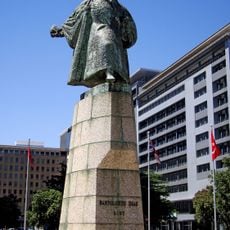
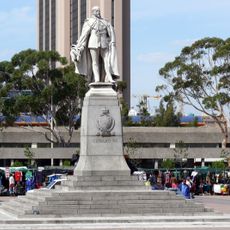
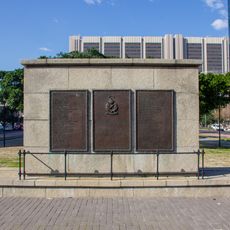
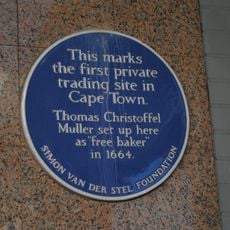
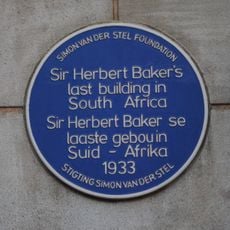
Statue of Jan van Riebeeck, Bronze monument in City Center, South Africa.
The statue of Jan van Riebeeck stands on Heerengracht Street in Cape Town, with its back to the sea and facing Table Mountain. The bronze figure, larger than life-size, holds a walking stick in his right hand and has his sword sheathed. It rests on a Cape granite pedestal 4¼ m high designed by an architect friend of sculptor John Tweed.
Cecil Rhodes donated the bronze to Cape Town and paid Scottish sculptor John Tweed £1,000, on condition that Tweed's name not appear on it and that it be larger than life. Mayor Thomas Ball unveiled it on 18 May 1899, with the City Council present but Rhodes absent in Europe. It stands on a Cape granite pedestal 4¼ m high, on the spot where Van Riebeeck was believed to have come ashore.
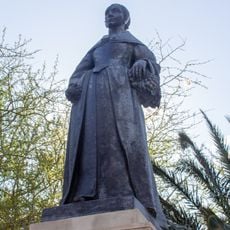
Peter Blum's 1950s poem "Oor monnemente gepraat" mocks the statue as "Jan van Riebeeck, very handsome in his plus fours". Until recently, wreaths were laid at the statues of Jan and Maria van Riebeeck every 6 April, Van Riebeeck Day or Founders Day. The figure's sword is sheathed and he holds a walking stick in his right hand.
The two statues stand on a traffic roundabout on Heerengracht Street, with their backs to the sea and facing Table Mountain to the south. Approach on foot from the surrounding pavements; the bronze figures and the 4¼ m Cape granite pedestal are best seen from the roadside rather than from close up.
The statue's dress is historically wrong in several ways: the overhanging shoulder straps were out of fashion by the mid-17th century, and the knee breeches and jacket only became popular after Van Riebeeck left for Java. Hat feathers were fashionable at the time but are missing from the figure.
The community of curious travelers
AroundUs brings together thousands of curated places, local tips, and hidden gems, enriched daily by 92,853 contributors worldwide.