Banyunibo Temple, Buddhist temple complex in Cepit, Indonesia
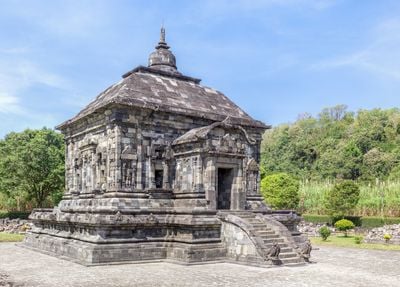
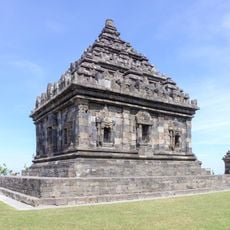
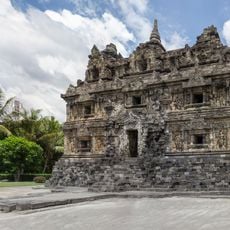
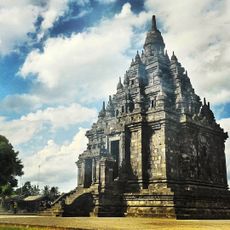
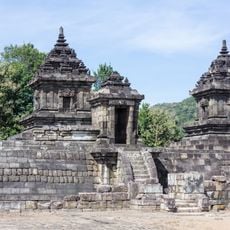
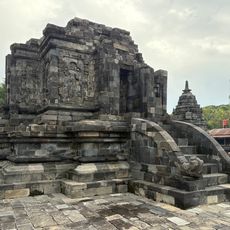
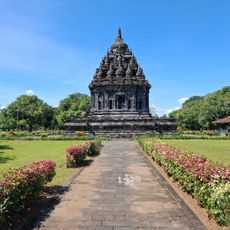
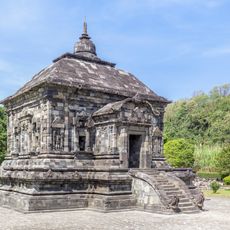
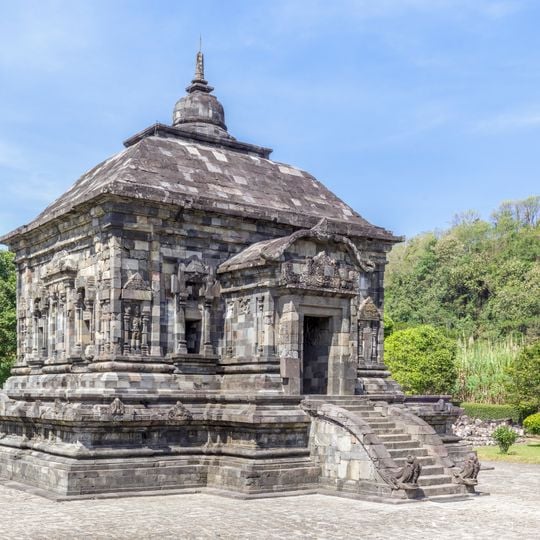
Banyunibo is a 9th-century Buddhist temple in Cepit hamlet, Bokoharjo, built of stacked grey andesite blocks on a stepped, moulded base. Its tiered pyramidal roof is crowned by a solitary stupa, and a projecting entrance porch with a curved, sculpted pediment faces west. Stone steps with side walls lead to the doorway; niches and relief panels decorate the side walls, and small carved figures sit at the foot of the steps.
Banyunibo was built in the 9th century under the Mataram kingdom. Its collapsed ruins were found in November 1940; research until 1942 rebuilt the roof and portal, then stopped during World War II and the Indonesian National Revolution. Work resumed and the sub-basement, foot, walls and north wall were finished in 1962, with full reconstruction completed in 1978.
The name Banyunibo means "dripping water" in Javanese, though no spring or drip exists at the site. Inside, the wall reliefs show Hariti surrounded by children and, separately, Vaisravana; a bald man under an umbrella held by servants may be a patron. Niches on the body hold Bodhisattvas, and window niches hold taras holding flowers.
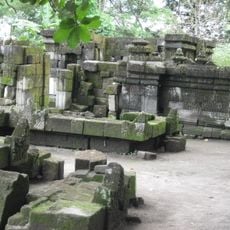
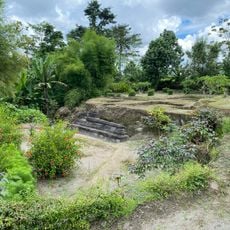
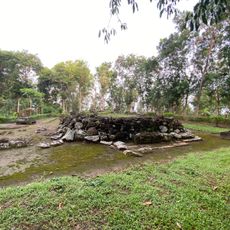
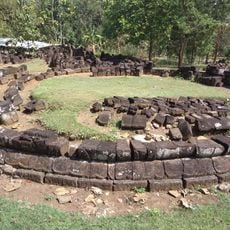
The temple stands in a narrow valley among paddy fields, about two kilometres southeast of the Ratu Boko archaeological park and roughly 5.6 km south of Prambanan. The main structure faces west, so the carved portal and its Kala-Makara ornament are seen from the approach path. The foundations of the surrounding stupas lie at ground level on the south and east sides.
The name Banyunibo means "dripping water" in Javanese, yet no spring or trickle exists at the site. The temple stands in a narrow valley among paddy fields, about two kilometres southeast of the Ratu Boko archaeological park, with the Gunung Sewu hills further south.
The community of curious travelers
AroundUs brings together thousands of curated places, local tips, and hidden gems, enriched daily by 93,200 contributors worldwide.