City Botanic Gardens, Botanical garden in Brisbane, Australia
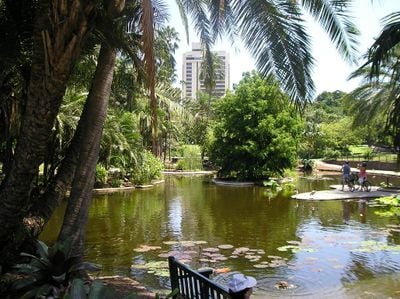
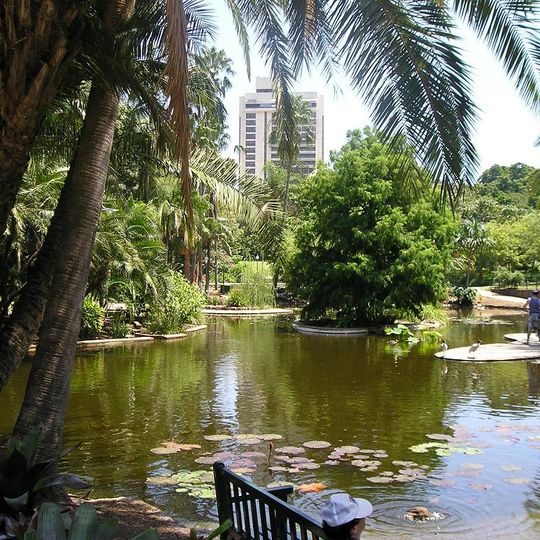
The City Botanic Gardens occupies about 20 hectares at Gardens Point, bounded by the Brisbane River, Alice Street, George Street, Parliament House and the QUT Gardens Point campus. Its collection focuses on cycads, palms, figs and bamboo, with fig avenues and bunya and Cook pine plantings. A dark olive-green pond edged with lily pads and a curved pale stone rim lies among the planting, and the 1867 Walter Hill fountain, designed by Charles Tiffin, still stands in the grounds.
Its origin traces back to a farm for the Moreton Bay penal settlement in 1825, which was later transformed into a botanical reserve. The conversion happened in 1855 as part of developing Brisbane's public spaces.
The gardens were long known as Queen's Park, and a 10-acre strip along Alice Street served as a cricket and football ground. The stone and iron fence built around it in 1865–66 used stone from the old gaol on Petrie Terrace; the Walter Hill fountain, designed by Charles Tiffin, followed in 1867.
The gardens sit at Gardens Point, bounded by the Brisbane River, Alice Street, George Street, Parliament House and the QUT campus, so entry on foot from the CBD is direct. Because of the river proximity the site has flooded nine times between 1870 and 2011. The former curator's cottage built for John Frederick Bailey is now a cafe.
The world's first cultivated macadamia tree was planted here in 1858 by curator Walter Hill, who ran acclimatisation trials of commercial plants. The gardens also saw Queensland's first granulated sugar produced in April 1862 from cane grown with Hill's support of John Buhot; a cairn marks the cane plot.
The community of curious travelers
AroundUs brings together thousands of curated places, local tips, and hidden gems, enriched daily by 93,825 contributors worldwide.