Large Binocular Telescope, Double optical telescope at Mount Graham, Arizona, United States
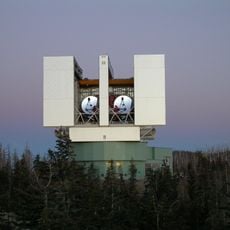
The Large Binocular Telescope stands on Mount Graham at 3,221 m, part of the Mount Graham International Observatory. Its two 8.4 m mirrors, centres 14.4 m apart, share one mount; the photograph shows them side by side in a white rectangular facade split by a central column, each held by thin white struts and a triangular support. Below sits a band of stacked white panels with a cylindrical white tube protruding on the right.
The telescope was originally called the Columbus Project and cost around 100 million euro, funded by partners in the United States, Germany and Italy. The San Carlos Apache Tribe and environmentalists filed some forty lawsuits over the Mount Graham site, eight reaching a federal appeals court, until an act of Congress let the project proceed. Dedicated in October 2004, it saw first light with one mirror on 12 October 2005, viewing NGC 891; the second mirror followed, and binocular observations began in January 2008.
Some members of the San Carlos Apache Tribe still connect this mountain to spiritual practices from their ancestors. The location led to conversations about access to sacred places and scientific research in an area with cultural meaning.
The facility uses an adaptive optics system to correct for atmospheric disturbances and produce especially sharp images. The system works best under the clear night sky conditions that occur at this remote high elevation.
When both mirrors work together in interferometric mode, the facility achieves the observing power of a much larger single telescope measuring roughly 22.8 meters (74.8 feet) across. This technique combines light from both mirrors to reveal details that would otherwise stay invisible.
The community of curious travelers
AroundUs brings together thousands of curated places, local tips, and hidden gems, enriched daily by 92,785 contributors worldwide.