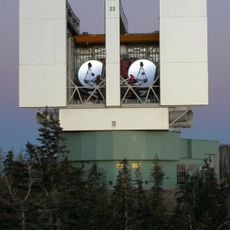
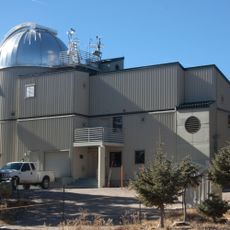
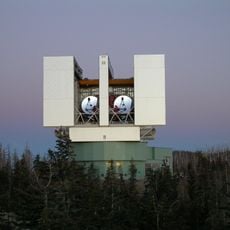
Heinrich Hertz Submillimeter Telescope, Radio telescope at Mount Graham International Observatory, Arizona, United States.
The Heinrich Hertz Submillimeter Telescope is a 10-meter parabolic dish inside a building on Mount Graham, Arizona. The building's roof and front doors open when the telescope observes. The dish weighs 135 tonnes and its mirror surface is made of 176 panels.
Built jointly by the Max Planck Institute for Radio Astronomy and the University of Arizona's Arizona Radio Observatory, the telescope began operating in 1993. It was later named after Heinrich Hertz, and today the Arizona Radio Observatory runs it alone. In 2017 it joined the Event Horizon Telescope network that produced the first direct image of a black hole.
The telescope is named after Heinrich Hertz, who demonstrated electromagnetic waves in 1887. It joined the Event Horizon Telescope network, which in 2017 observed the black hole in galaxy M87; the image was published in April 2019. The Arizona Radio Observatory now operates it alone.
The dish sits at 3,186 metres on Mount Graham, inside a building whose roof and front doors open only for observing. It is used nine to ten months a year and stowed when water vapour rises, mainly in summer. Guided tours of the observatory are arranged through Discovery Park.
The dish's surface is made of 176 panels, and the whole 135-tonne telescope sits at 3,186 metres on Mount Graham. In 2017 it joined the Event Horizon Telescope network that produced the first direct image of a black hole, published in April 2019.
The community of curious travelers
AroundUs brings together thousands of curated places, local tips, and hidden gems, enriched daily by 92,831 contributors worldwide.