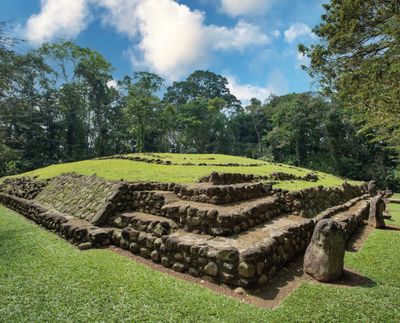
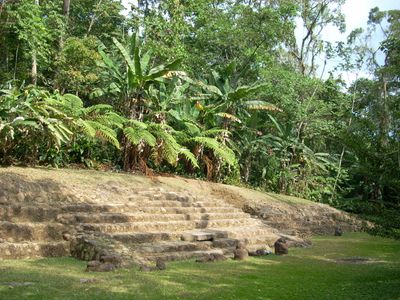
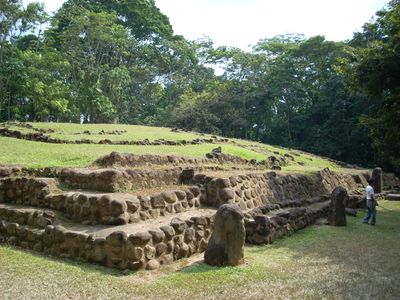
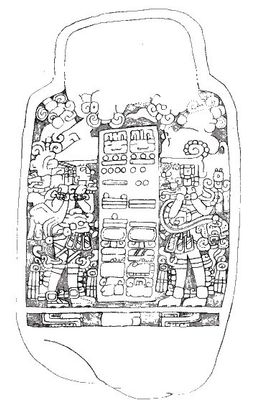
Takalik Abaj, Pre-Columbian archaeological site in El Asintal, Guatemala.
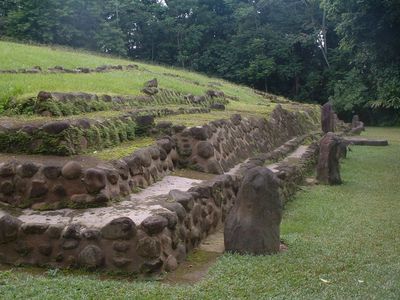
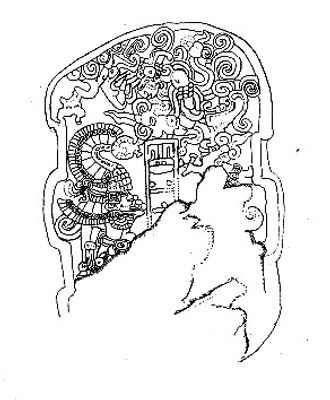
Takalik Abaj is an archaeological complex with nine terraces containing 70 monumental structures, stone sculptures, and ceremonial platforms spread across a forested subtropical landscape. The various buildings are distributed across the site and together form a large religious and administrative center.
Takalik Abaj was occupied from the 9th century BC to at least the 10th century AD, and its architecture shows Olmec influence in the Middle Preclassic before Maya features developed. It traded with Kaminaljuyu and Chocolá, and finds indicate contact with Teotihuacan. On 18 September 2023 it was inscribed as a UNESCO World Heritage Site.
The name Tak'alik Ab'aj' comes from K'iche' Maya: tak'alik means "standing" and abäj means "stone". Archaeologist Suzanna Miles first called it Abaj Takalik in Spanish word order, which is incorrect in K'iche'; the Guatemalan government now uses Tak'alik Ab'aj'. Anthropologist Ruud Van Akkeren proposed the ancient name Kooja, meaning "Moon halo", after a high-ranking Mam Maya lineage.
Visitors can join guided tours through the archaeological structures with informative panels explaining the significance of each monument. The site lies in a forested area, so come prepared for uneven ground and humid conditions.
The site's name was coined by archaeologist Suzanna Miles, who used Spanish word order to form "Abaj Takalik"; in K'iche' the correct order is Tak'alik Ab'aj', meaning "standing stone", and Guatemala has adopted this official form. Anthropologist Ruud Van Akkeren proposed the ancient name Kooja, "moon halo", from a high-ranking Mam lineage.
The community of curious travelers
AroundUs brings together thousands of curated places, local tips, and hidden gems, enriched daily by 92,893 contributors worldwide.