Chocolá, Archaeological site in San Pablo Jocopilas, Guatemala.
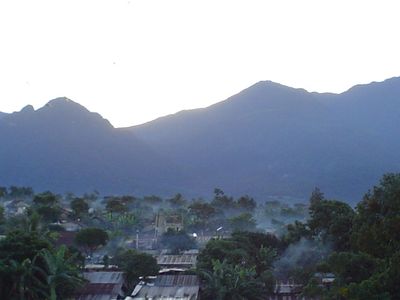
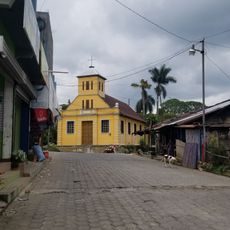
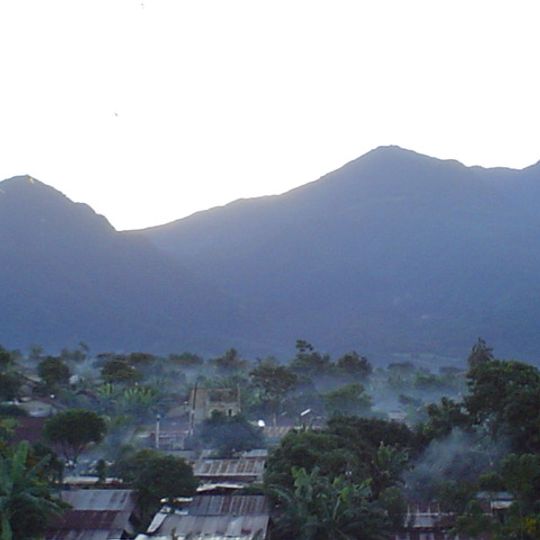
Chocolá is a Preclassic Maya site in San Pablo Jocopilas, Suchitepéquez, laid out over roughly 6 by 2 kilometers from north to south. Its northern sector holds platform mounds of elite residences and palaces, among them Structure 7-1, about 25 by 25 meters and 5 meters high; the central district has pyramidal mounds up to 25 meters. A modern village covers much of the ruins, and in the photograph a pale tan wall section with an opening stands beside long rusting corrugated-metal roofs among trees.
Chocolá was a Preclassic Southern Maya centre whose main development ran from c. 1000 BC to AD 200. Karl Sapper recorded more than 100 structures at the end of the 19th century, and Robert Burkitt excavated mounds in the 1920s, finding Monument 1, a stela in the Miraflores style. Long-term work by the Proyecto Arqueológico Chocolá began in 2003.
The site displays platform mounds and pyramid structures that reflect the building skills of early Maya inhabitants. These constructions tell of a society capable of organizing complex communities.
Reaching the site requires patience since modern buildings partly cover the ancient ruins and structures can be hard to identify. Visitors should consider hiring a local guide to properly understand the different areas.
Beneath the structures runs a sophisticated network of stone-lined channels that shows how early inhabitants managed water. This drainage system ranks among the oldest known examples of such technical complexity.
The community of curious travelers
AroundUs brings together thousands of curated places, local tips, and hidden gems, enriched daily by 92,815 contributors worldwide.