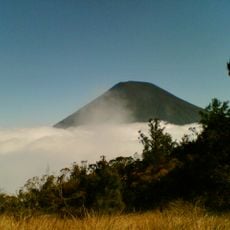
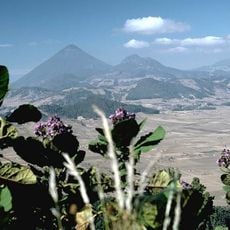
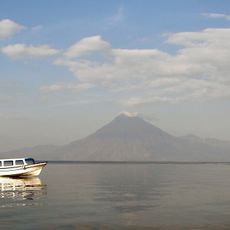
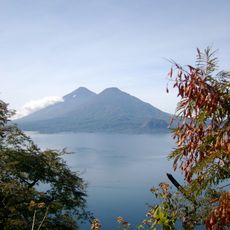
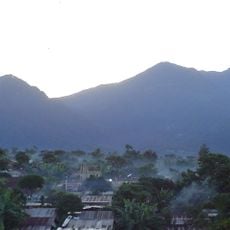
Santiaguito, Active lava dome complex in Quetzaltenango Department, Guatemala.
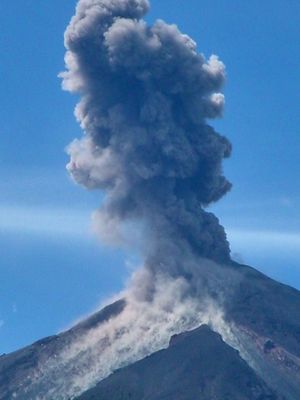
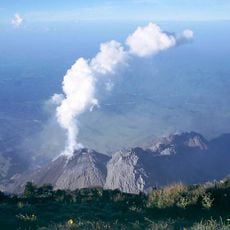
Santiaguito is a lava dome complex on the southwestern flank of Santa María, in Quetzaltenango Department, Guatemala, at about 2,550 m. Its small domes with steep slopes grew from the accumulation of very viscous lava and incandescent ash flows. The complex is classified as Pelean type for its explosive tendency and gas-rich magma, and rock blocks occasionally fall from the dome and lava-flow edges.
The complex started growing in 1922 after Santa María erupted violently in 1902, ejecting around 8 cubic kilometers of magma. Since then, the eruption has remained continuously active, building up the four domes over the decades that now form the massif.
Local mountaineers and tourists come to watch the dome's constant small explosions and glowing ash flows from viewpoints around the volcano. The 1929 pyroclastic flows down the Tambor riverbed killed more than 2,500 people and destroyed 55 hectares of coffee plantation and 39 hectares of pasture at Finca El Patrocinio. The 1982 eruption forced thousands of residents to evacuate and led to El Palmar being declared an uninhabitable zone.
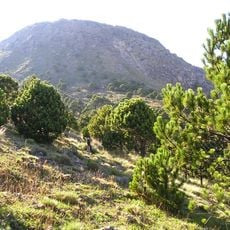
Visitors need to get permission from local authorities and hire certified guides to reach observation points where they can watch the small eruptions. The climb follows steep and sometimes loose trails, so sturdy footwear and good physical fitness are necessary.
The nearly continuous eruption activity for over 100 years ranks among the longest documented eruption sequences worldwide. Scientists often use the site to study volcanic processes in real time and improve forecasting models.
The community of curious travelers
AroundUs brings together thousands of curated places, local tips, and hidden gems, enriched daily by 92,648 contributors worldwide.