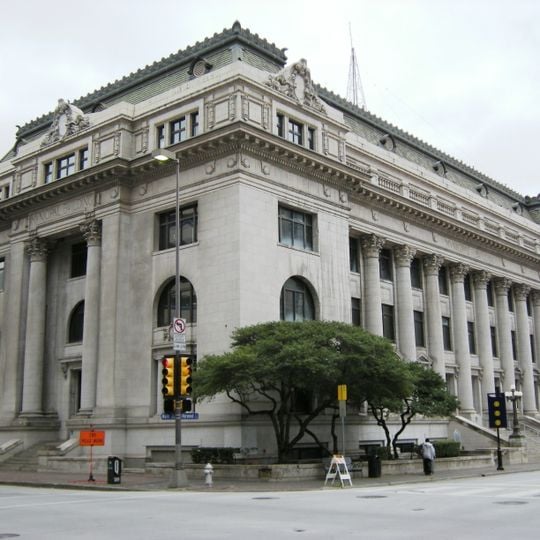
Dallas Municipal Building, Government building in downtown Dallas, United States.
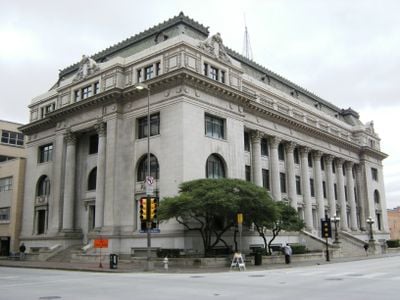
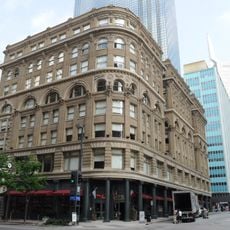
The Dallas Municipal Building is a Beaux-Arts government building of light grey stone at S. Harwood Street between Main and Commerce Streets in downtown Dallas. Two facades meet at a corner bay; the base has tall columns flanking entrances and arched windows, and an entablature inscribed "MUNICIPAL BUILDING" runs above. The upper story has rectangular windows beneath a heavy carved cornice, topped by an attic level and a dark, slightly overhanging roof with a cresting along its edge.
The city bought the land in 1911–1912 from Eliza Trice, Otto H. Lang and the Sweeney family; C. D. Hill & Company designed the Beaux-Arts building, which opened on October 17, 1914 after C. C. Street, Jr. took over from a bankrupt contractor. It served as Dallas's fourth City Hall until 1978. On November 22, 1963, Lee Harvey Oswald was arrested and jailed here, and two days later Jack Ruby shot him in the basement garage.
The building expresses how Dallas wanted to showcase its growth as a major city through classical design choices in the early 1900s. The grand columns and ornate details were meant to convey authority and permanence to visitors and residents alike.
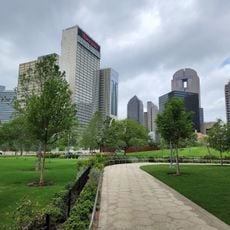
The building occupies the block of S. Harwood Street between Main and Commerce Streets, facing Main Street Garden Park across the street. The University of North Texas at Dallas College of Law moved into the renovated structure in July 2020. Walk the two street facades at the corner to read "MUNICIPAL BUILDING" carved on both entablatures.
The basement garage where Jack Ruby shot Lee Harvey Oswald on November 24, 1963, two days after Oswald was jailed here, is the detail most passers-by miss. The building later sat partly abandoned until the University of North Texas at Dallas College of Law renovated it, completing work in 2020 and moving in that July.
The community of curious travelers
AroundUs brings together thousands of curated places, local tips, and hidden gems, enriched daily by 94,450 contributors worldwide.