Lake Enriquillo, Salt lake in Independencia, Dominican Republic
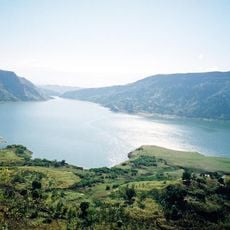
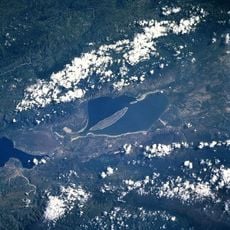
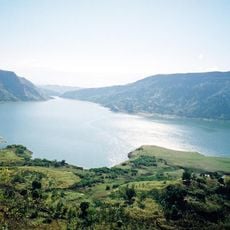
Lake Enriquillo is a hypersaline, endorheic lake in the Hoya de Enriquillo, shared by Independencia and Bahoruco provinces. Its surface lies about 29 m below sea level, and its area has varied widely: 164 km² in 2004, 350–380 km² by 2011. Isla Cabritos, a long strip pointed at both ends, is the only remaining island; Barbarita and Islita were submerged by late 2011.
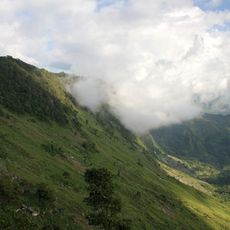
The lake was formerly called Lake Xaragua, after the Taíno chiefdom in which it lay. It was later named after Enriquillo, a Taíno cacique who rebelled against the Spaniards in the early 16th century and hid in the mountains south of the lake. The valley itself is a former marine strait that was cut off about one million years ago when the water level fell and sediments of the Yaque del Sur River filled it.
The lake takes its name from Enriquillo, the Taíno cacique who rebelled against the Spanish in the early 16th century and hid in the mountains south of the water; it was earlier called Lake Xaragua after the chiefdom there. Near La Azufrada stand petroglyphs known locally as "las caritas", possibly pre-Taíno, carved at a spot overlooking the lake and its islands.
The lake is reached most easily from nearby towns where boat tours can be arranged to explore the water and its wildlife. The best time to visit is during drier months when conditions are more favorable for observation and access.
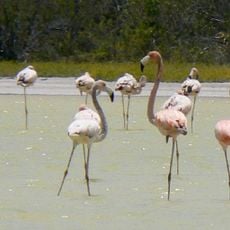
The lake holds the Caribbean's largest wild population of American crocodiles, the only one left in the Dominican Republic; the country's other populations have disappeared. The reptiles feed on introduced tilapia. Two Hispaniola-endemic iguanas, Ricord's and the rhinoceros iguana, live on and around Isla Cabritos.
The community of curious travelers
AroundUs brings together thousands of curated places, local tips, and hidden gems, enriched daily by 93,360 contributors worldwide.