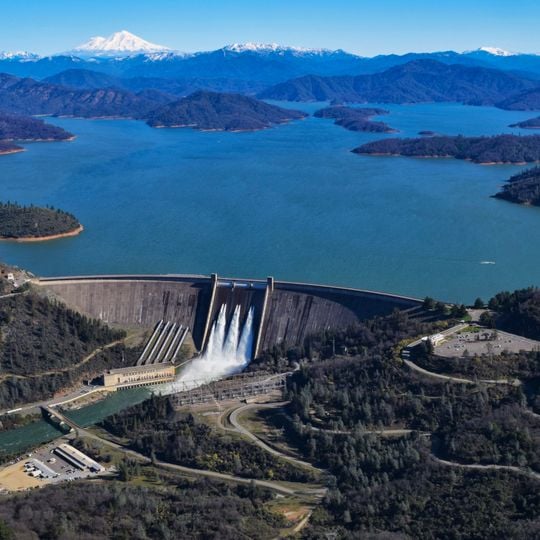
Shasta Dam, Concrete arch-gravity dam in Shasta County, California.
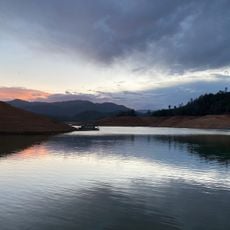
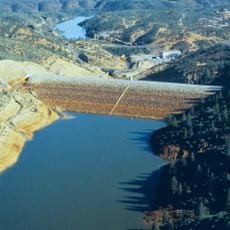
Shasta Dam is a concrete arch-gravity dam that spans the Sacramento River and creates Shasta Lake, California's largest reservoir. The structure operates five turbines that manage water storage and flood control for the state's northern agricultural regions.
Shasta Dam was first proposed in 1919 by Robert Marshall of the USGS as a dam near the copper town of Kennett, and California's 1931 State Water Plan revived the idea. After state bonds failed during the Depression, President Roosevelt authorized it in 1935 as part of the Central Valley Project. Construction ran from 1937 to 1945 under Chief Engineer Frank Crowe, finishing 26 months ahead of schedule.
The construction flooded the pioneer settlement of Kennett and sacred sites of the Winnemem Wintu people beneath the lake's surface. This loss remains part of the local communities' connection to this place today.
The dam stands at the north end of the Sacramento Valley near Redding, where the Sacramento River meets the Pit River. The powerhouse sits at the foot of the downstream face, reached by the river channel below the spillway. The reservoir, Shasta Lake, is California's largest and serves irrigation, hydropower and recreation.
The dam's concrete volume is about 4 million cubic metres, and its five Francis turbines produce 610 MW, making it California's largest conventional hydroelectric plant. Water drops 100 metres through five pipes 4.5 metres in diameter, and the current is stepped up from 13,800 to 230,000 volts for transmission.
The community of curious travelers
AroundUs brings together thousands of curated places, local tips, and hidden gems, enriched daily by 92,783 contributors worldwide.