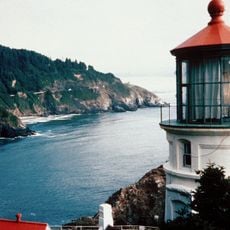
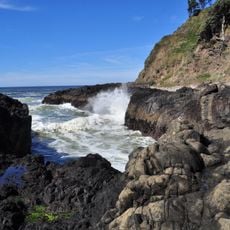
Cape Creek Bridge, Road bridge in Lane County, United States
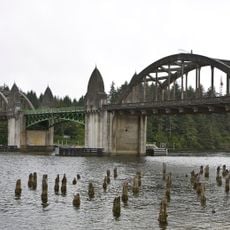
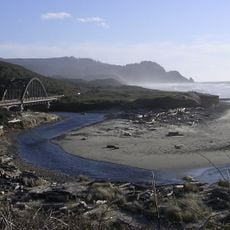
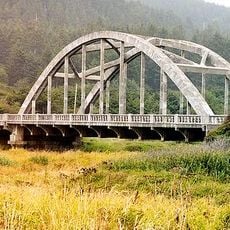
Cape Creek Bridge is a concrete arch bridge that spans across Cape Creek on U.S. Route 101 in the Oregon coast region. The structure features a large parabolic arch as its central element, supporting the roadway above the creek and surrounding terrain below.
Conde McCullough designed the bridge for the Oregon Coast Highway, modelling it on the Roman aqueduct Pont du Gard. Work began in April 1931 under John K. Holt of Salem and the Clackamas Construction Company of Oregon City, and finished in April 1932. The Heceta Head to Sea Lion Caves stretch, including the Devil's Elbow tunnel, was among the highway's costliest sections.
The National Register of Historic Places includes this bridge as part of the C. B. McCullough Major Oregon Coast Highway Bridges collection.
The deck is 8.2 m wide between curbs, with a 1 m sidewalk on each side behind a concrete railing, so pedestrians cross beside traffic. The bridge slopes 3.5 degrees, dropping from about 21 m of structure on the south side to under 18 m on the north. It links the Devil's Elbow tunnel to the Heceta Head stretch of U.S. 101.
Since 1991 the concrete has carried a sprayed zinc coating acting as a sacrificial anode, part of an impressed-current cathodic protection system; contractors plasma-sprayed 102,000 square feet of 0.020-inch zinc to stop seawater chloride from corroding the rebar. The concrete and railing were repaired again between 2013 and 2014.
The community of curious travelers
AroundUs brings together thousands of curated places, local tips, and hidden gems, enriched daily by 92,856 contributors worldwide.