Wallula Gap, Water gap and National Natural Landmark in Washington, United States
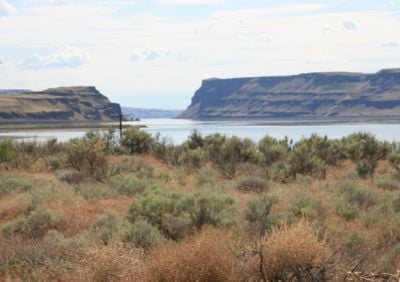
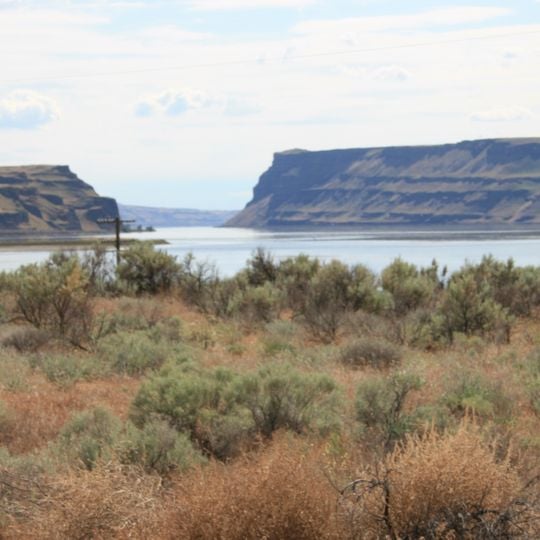
Wallula Gap is a water gap where the Columbia River cuts through the folded basalt of the Horse Heaven Hills in southeastern Washington. The gap is about 2 km wide, with a dark, layered bluff on one side and a taller wall of horizontally banded grey and brown rock on the other. The river below is pale blue-grey, and a single wooden utility pole with a wire stands on the far bank.
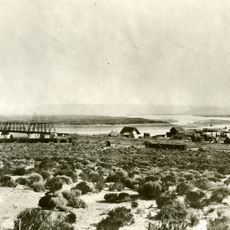
The gap was cut by the ancestral Salmon-Clearwater River through the lowest point of the Horse Heaven Hills anticline, and the Columbia joined it about six million years ago. Around the 14th millennium BC, Missoula floods widened it; water backed up in the Pasco Basin to form Lake Lewis. Lewis and Clark saw the gap on 18 October 1805, and in the 1840s Oregon Trail pioneers stopped at Wallula to convert wagons into boats.
Native American tribes established settlements near Wallula Gap, utilizing the Columbia River's resources and the natural passage for transportation and trade.
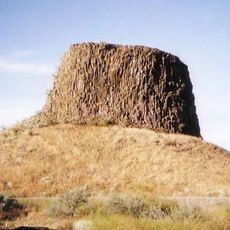
The gap lies just south of where the Walla Walla joins the Columbia, crossed by Route 730 on the Washington side. The Columbia is about 2 km wide here, so the far cliff is best seen from the opposite bank. Twin Sisters, the basalt pillars of Cayuse legend, stand upstream near Port Kelley and are reached on foot.
The gap is only 2 km wide, so during the Missoula floods less than a fifth of the roughly 800 km³ of water arriving each day could pass through. Water backed up into the Pasco Basin, briefly forming Lake Lewis, and the peak flow through the constriction is estimated at about 10 million cubic metres per second.
The community of curious travelers
AroundUs brings together thousands of curated places, local tips, and hidden gems, enriched daily by 94,186 contributors worldwide.