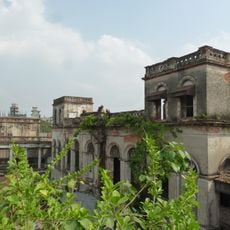
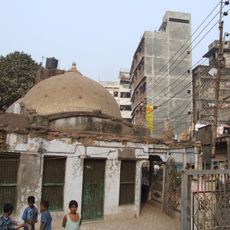
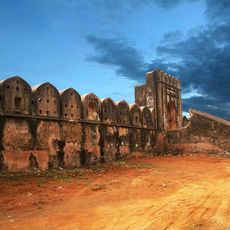
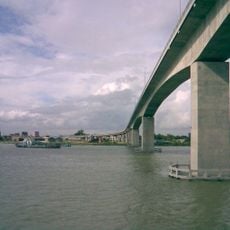
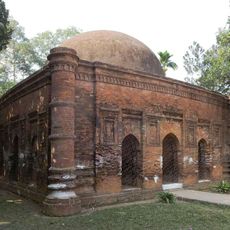
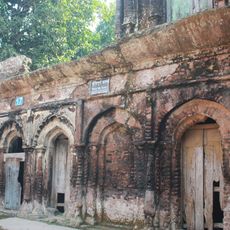
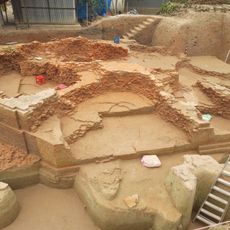
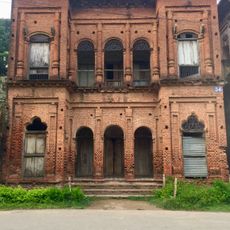
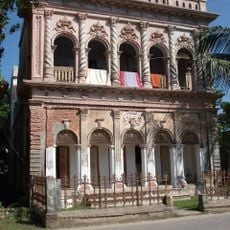
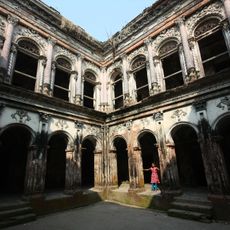
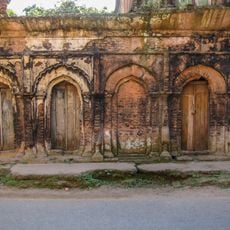
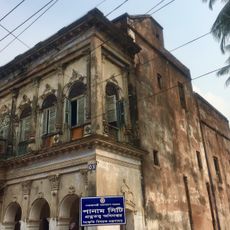
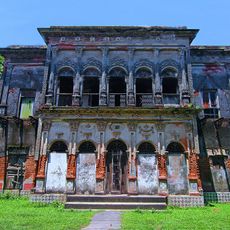
Baba Adam's Mosque, 15th-century Islamic religious complex in Munshiganj District, Bangladesh.
Baba Adam's Mosque is a 15th-century Islamic religious complex in Munshiganj featuring six domes arranged in two rows and supported by black basalt pillars. The pillars carry chain and bell decorative elements that define the building's interior and exterior.
An Arabic inscription above the central east doorway records that Malik al-Muʿazzam Malik Kafur, an officer of Abyssinian origin according to historian Ahmad Hasan Dani, built the mosque in Rajab 888 AH (August/September 1483) under Sultan Jalaluddin Fateh Shah. The tomb of Baba Adam Shahid, a 15th-century preacher killed fighting a local Hindu king, stands in the courtyard. The Department of Archaeology has supervised the monument since 1948.
The mosque is still used for regular congregational prayer, and the tomb of Baba Adam Shahid, a 15th-century Muslim preacher killed in battle with a local Hindu king, stands in its courtyard. The building is named after him, and Malik Kafur had it raised in his memory.
The mosque stands in Qadi Qasbah village, Rampal Union, Munshiganj District, and is still used for regular congregational prayer, so visits are best timed outside prayer hours. The Department of Archaeology has supervised the site since 1948 and fenced it with an iron boundary in 1991. The central of the three eastern archways is the entrance in use.
The building stands out by having no minaret, which was uncommon for mosques of that era. This feature makes it a notable example of how religious architecture could differ from typical patterns of the time.
The community of curious travelers
AroundUs brings together thousands of curated places, local tips, and hidden gems, enriched daily by 93,430 contributors worldwide.