Shanghai Yangtze River Tunnel and Bridge, Bridge-tunnel system in Shanghai, China
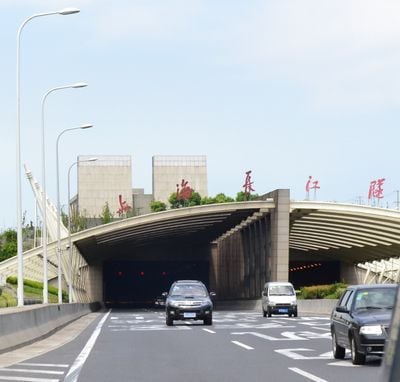
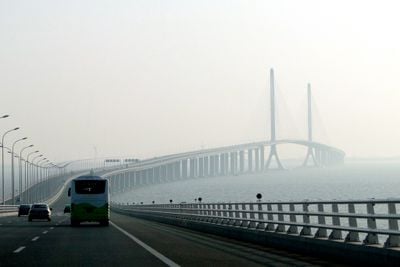
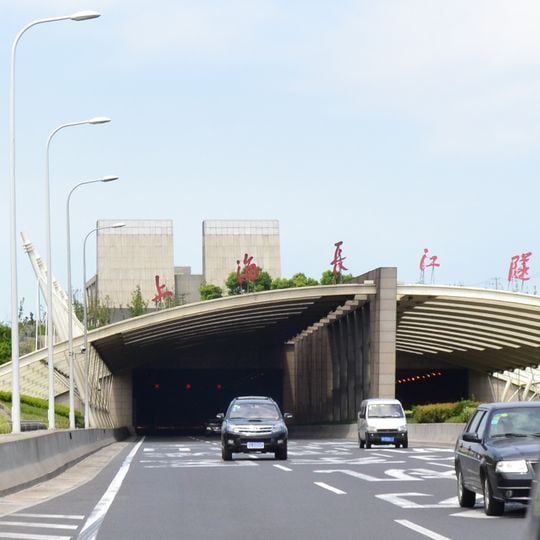
The Shanghai Yangtze River Tunnel and Bridge is a 25.5 km bridge–tunnel complex across the south fork of the Yangtze. The 8.9 km tunnel runs from Wuhaogou in Pudong to southern Changxing Island, then the 16.63 km bridge crosses Changxing at ground level and reaches Chongming at Chenjia Town. The bridge is S-shaped, with a 730 m central cable-stayed span between two inverted-Y concrete pylons and paired concrete piers carrying a pale grey deck with a metal guardrail and round lamps.
Built between 2005 and 2009 at a cost of 12.6 billion yuan, the complex opened on 31 October 2009. The bridge was joined on 27 June 2008, and its steel deck received epoxy asphalt paving in August 2009. With the Chongqi Bridge added in December 2011, it forms the last Yangtze crossing before the East China Sea.
Bus routes named Shenchong 1 to 6 and the Chenfeng line use the bridge, with stops at Chenjia Town (Changjiang Bridge), Changxing Island hub and Chongming Nanmen. The crossing is also known as the Chongming river crossing or Hu-Chong project, and its name appears in Chinese as 上海长江隧桥.
The bridge carries three lanes in each direction with a 100 km/h design speed; the tunnel has three lanes each way at 80 km/h. Toll booths sit at Wuhaogou in Pudong and at Chenhai Road on Chongming, plus a ramp station on Panyuan Road, Changxing Island. Capacity is 3,200 vehicles per hour, so queues build up on public holidays; lane signal control was introduced toward Shanghai on 21 January 2024.
The system features eight specialized dampers that help the structure withstand earthquakes, strong winds, and heavy loads from fast-moving traffic. These devices simultaneously allow the structure to expand and contract naturally with temperature changes.
The community of curious travelers
AroundUs brings together thousands of curated places, local tips, and hidden gems, enriched daily by 93,473 contributors worldwide.