Yungbulakang Palace, Ancient palace in Nêdong District, China
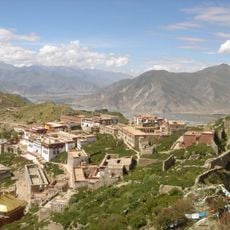
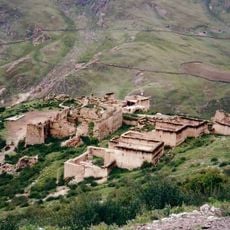
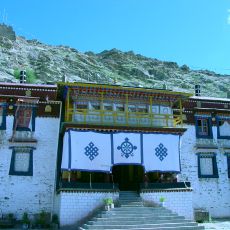
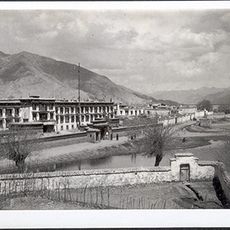
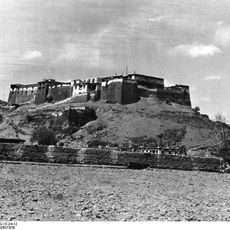
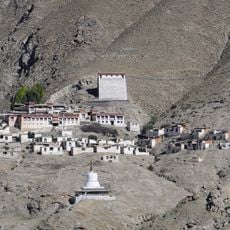
Yungbulakang Palace stands on a hill at a bend of the Yarlung Tsampo River, 9 km south of Tsetang. Its front precinct is a three-storey building, while the rear is dominated by a tall castle-like tower. The white walls with red trim enclose a courtyard, and a white cylindrical stupa with a pointed top stands on the right side of the roofline. A winding path leads up the left slope.
According to tradition, Nyatri Tsenpo, the first Tibetan king, built Yumbulagang in 127 BCE, making it Tibet's earliest palace. In the 7th century it became the palace of the 33rd king, Songtsen Gampo, and his Chinese queen Wencheng. After the capital moved to Lhasa it served as a shrine, and the 5th Dalai Lama turned it into a Gelug monastery. Demolished during the Cultural Revolution, it was partially rebuilt in 1983 and restored in 2017–2018.
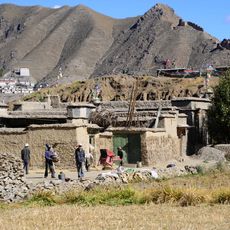
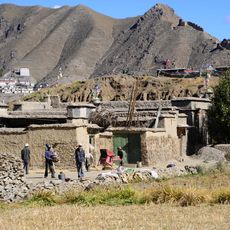
Murals inside depict the first Tibetan king Nyatri Tsenpo, the first building and the first ploughed field. Nearby, farmers still scatter soil from Zorthang, Tibet's largest traditional cultivated area, on their own fields for a good harvest. A spring 400 metres northeast, the Ga Spring, is credited to Songtsen Gampo's minister Gar Tongtsen and is drunk by pilgrims.
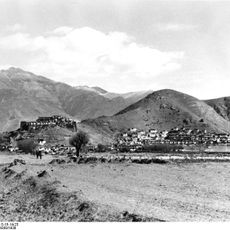
The palace stands on Tashi Cêri hill about 9 km south of Tsetang, reached by a winding path up the slope. In the ravine some 400 m northeast of the building a spring, the Ga spring, is said to have been found by Gar Tongtsen during Songtsen Gampo's reign; pilgrims drink from it. The site reopened in April 2018 after restoration work begun in November 2017.
The watchtower at the rear measures roughly 11 meters tall and provides views over the entire valley. This defensive structure shows early fortification techniques used in Tibetan building design.
The community of curious travelers
AroundUs brings together thousands of curated places, local tips, and hidden gems, enriched daily by 93,848 contributors worldwide.