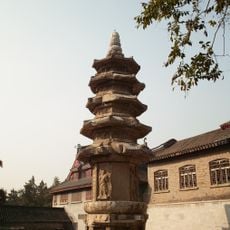
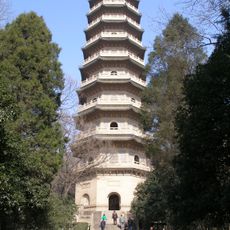
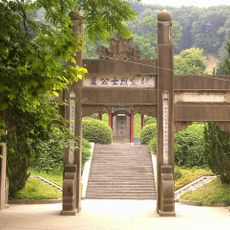
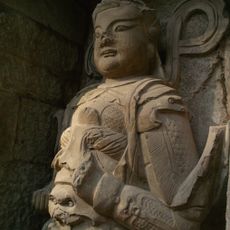
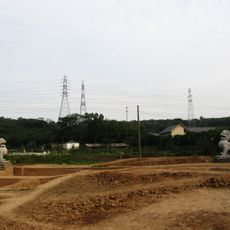
Longchang Temple, Buddhist temple on Mount Baohua in Jurong, China
Longchang Temple stands on Mount Baohua in Jurong, Jiangsu. Its Copper Hall, donated in 1605 by Empress Dowager Xiaoding with two thousand taels of gold, is 7 m high, 4.5 m wide and 4 m deep, with a double-eave gable-and-hip roof and statues of Guanyin inside. Flanking it are two Beamless Halls, each 7.62 m wide and 5.62 m deep, built without pillars or columns: the left enshrines Wenshu, the right Puxian.
The temple was founded in 502 as Qianhua Temple by the monk Baozhi during the Liang dynasty. In the Wanli era of the Ming, the emperor bestowed a set of Chinese Buddhist canon and renamed it Huguo Shenghua Longchang Temple. The Kangxi Emperor renamed it Huiju Temple during his southern tours; in 1931, at the suggestion of Dai Chuanxian, president of the Examination Yuan, the name Longchang was restored.
The temple gives its name to the Vinaya tradition's foremost mountain, and its ordination platform, carved in stone in 1705 to the design of master Jianyue, still anchors that reputation. The name Longchang was bestowed by the Wanli Emperor in 1605; after 1931, at the suggestion of Dai Chuanxian, the temple reverted to it after a Qing-era interval as Huiju Temple.
The temple sits on Mount Baohua, about 23 km east of Nanjing's Zhongshan Gate. The Copper Hall and the two Beamless Halls stand together in the upper courtyard, with the 400-year-old ginkgo trees nearby. The Hall of Ordination, the temple's central hall, holds the stone altar carved in 1705.
The Copper Hall is 7 metres high, 4.5 metres wide and 4 metres deep, with a double-eaves gable and hip roof. Empress Dowager Xiaoding gave two thousand taels of gold for it in 1605. In March 2013 it was listed, together with the Beamless Halls, as a Major National Historical and Cultural Site in Jiangsu.
The community of curious travelers
AroundUs brings together thousands of curated places, local tips, and hidden gems, enriched daily by 94,548 contributors worldwide.