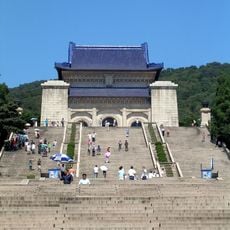
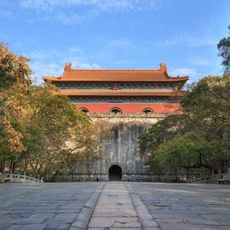
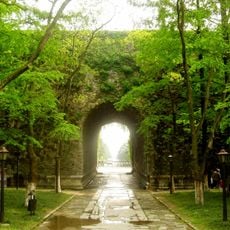
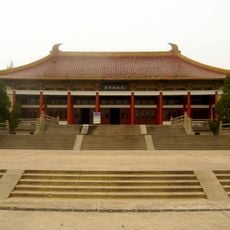
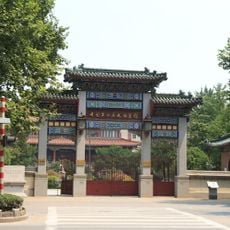
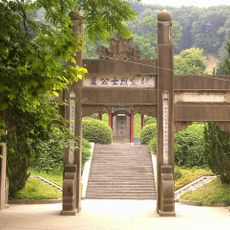
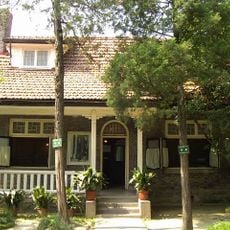
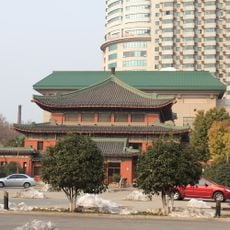
Linggu Temple, Buddhist temple in Purple Mountain, Nanjing, China.
Linggu Temple stands on the southeast slope of Purple Mountain, about 1.5 km east of the Sun Yat-sen Mausoleum in eastern Nanjing. Its grounds hold the brick-and-stone Wuliang Hall of 1381, the 60.5 m Linggu Pagoda, the Three Superb Tablet, a hall for Xuanzang's relics, and the tombs of Tan Yankai and Deng Yanda.
The temple began in 514 as Kaishan Jingshe, built by Emperor Wu of Liang for the monk Baozhi on the southern slope of Dulongfu on Purple Mountain. In 1381 the Hongwu Emperor moved it to its present site to make way for his Xiaoling Mausoleum and named it Linggu Chan Temple. Most buildings were destroyed during the Taiping fighting under the Xianfeng Emperor and rebuilt on a smaller scale under the Tongzhi Emperor.
The temple houses important artworks including a famous set of stone tablets featuring works by Tang Dynasty artists. These tablets show how painting, poetry, and calligraphy were valued across centuries.
The grounds are easy to reach by public transportation and can be visited from early morning until evening. Good pathways connect the different buildings, and the grounds are suitable for a leisurely walk.
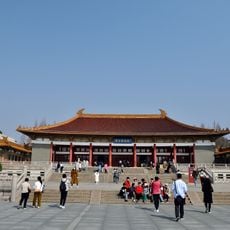
The Beamless Hall survived the wars that destroyed most of the temple because it has no timber: bricks and mortar form its five barrel vaults, the central one 14 metres high. Its side walls step inward by about a metre without falling. In 1933 it became the memorial hall for over 30,000 soldiers of the Northern Expedition.
The community of curious travelers
AroundUs brings together thousands of curated places, local tips, and hidden gems, enriched daily by 94,362 contributors worldwide.