Haotian Pagoda, Buddhist pagoda in Fangshan District, China.
Haotian Pagoda is a five-tiered tower with an octagonal shape rising about 36 meters high in Fangshan District. Each level features four doorways aligned with the four cardinal directions that organize the interior space.
The pagoda was first built in the Sui dynasty alongside Fazang Temple, and the present brick tower was rebuilt in 1068, the fourth year of the Liao Xianyong era. It was repaired in the Tang and later dynasties. In 1901 Eight-Nation Alliance troops destroyed the Buddha figures in the arched doorways. It was listed as a Beijing protected site in 1979 and a national one in 2013.
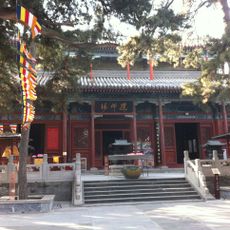
Local lore links the pagoda to the story of Meng Liang stealing the bones of the Song general Yang Ye, said to have been hidden here; the tale became a Peking opera, though Yang Ye never operated near Beijing. The park also displays a rebuilt Meng Liang tomb, a Jiaozan tomb and a bone-theft cave.
Local buses provide the best way to reach the pagoda and drop you near Haotian Park. Plan to climb the interior staircase at your own pace, and watch for uneven steps along the way.
This is the only hollow Buddhist pagoda in Beijing that visitors can explore from the inside. A spiral staircase connects all five levels and reveals how such towers were constructed internally with their working spaces.
The community of curious travelers
AroundUs brings together thousands of curated places, local tips, and hidden gems, enriched daily by 93,808 contributors worldwide.