White Pagoda, Ancient pagoda in Baita District, Liaoyang, China
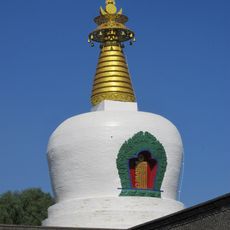
The White Pagoda is a solid, octagonal brick pagoda of closely spaced eaves in Baita Park, Baita District, Liaoyang. It rises 70.3 m from a tall stone platform, with a base, two-tiered sumeru pedestal, body, thirteen eaves and a finial. Its body and eaves are coated in white lime, hence the name. Carved lions, Buddhas with attendant bodhisattvas, flying figures and peonies cover the base and body.
The construction date is disputed: steles of 1590 and 1842 claim a Han-dynasty origin with Tang repairs, while a 1922 pagoda inscription and the Jin Shi point to a Jin date, completed in 1189 as a reliquary for the mother of Emperor Shizong. Other scholars, citing the 1423 repair stele and the tower's form, argue for a Liao origin. It was repaired under the Yuan, Ming and Qing, and its temple, Guangyou Temple, was burned by Russian troops in 1900.
The name White Pagoda comes from the white lime coating on its body and eaves. It was a relic and feng shui pagoda attached to Guangyou Temple, which Russian troops burned in 1900; only the pagoda survived. In 1908 the Japanese built Baita Park around it, and Baita District took its name from the pagoda in 1948.
The site is accessible throughout the day and located on a main street in the city center, making it easy to reach. Visitors should prepare for changing weather when exploring the structure.
The pagoda is solid brick with no interior stairway, so it cannot be climbed; the view from its top is not open to visitors. Look instead at the thirteen eaves: a bronze mirror is set on the false wall between each pair of eaves, and four plaques reading 流, 光, 碧 and 漢 hang beneath the first southern eave.
The community of curious travelers
AroundUs brings together thousands of curated places, local tips, and hidden gems, enriched daily by 93,086 contributors worldwide.