Main Hall of Zhenru Temple, Buddhist temple hall in Putuo District, Shanghai, China
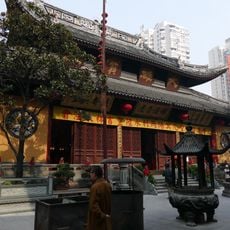
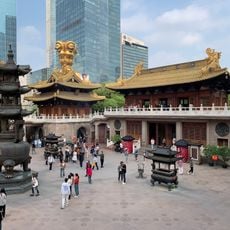
The Main Hall of Zhenru Temple is a square-plan hall, three bays wide and three deep, with a single-eaves hip-and-gable roof. Its interior holds 16 cypress columns: three inner columns 6.45 m tall and 40 cm in diameter, and eave columns 4.28 m high and 32 cm across. The inner columns lean inward by 16 cm and the eave columns by 8 cm. Most beams, architraves and bracket sets remain Yuan-era originals.
Built in 1320, the seventh year of the Yanyou era of the Yuan Dynasty, the hall was repaired three times during the Ming Hongwu, Hongzhi and Chongzhen reigns. In 1860 it was destroyed in fighting and rebuilt in 1895 by the monk Nianlun, who changed the single-eaved, three-bay structure into a double-eaved, five-bay one. It survived the Sino-Japanese War intact and was restored to a single eave in 1963–1964.
The main space holds a jade statue of Sakyamuni Buddha that reflects Buddhist spiritual practice and artistic skill. Visitors can observe how the statue's placement and craftsmanship shape the way people engage with the hall.
Visitors can reach this hall by taking Metro Line 11 to Zhenru Station and using Exit 5 toward Tongchuan Road. The age of the structure means some areas may have limited accessibility, so wear comfortable shoes for uneven surfaces.
The name Zhenru comes from the inscription "法界真如" on the plaque above the central south doors, not from the leaning columns. Inside, 26 ink characters in double-outline carving survive on a small beam beneath the inner lintel of the central bay, written by the Yuan-era carpenters.
The community of curious travelers
AroundUs brings together thousands of curated places, local tips, and hidden gems, enriched daily by 93,088 contributors worldwide.