White Dagoba, Buddhist stupa in Xicheng District, China.
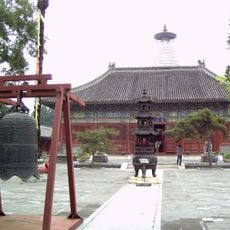
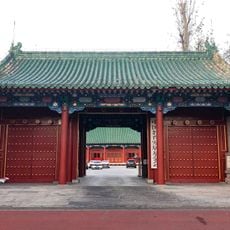
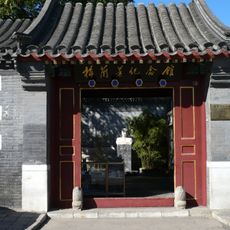
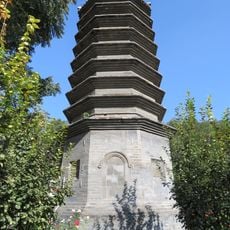
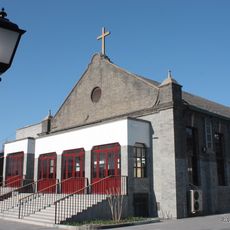
The White Dagoba is a chorten located in Beijing's Xicheng District that rises approximately 51 meters above street level. Its design displays Tibetan architectural features with detailed carved surfaces, and the surrounding complex includes several temple halls dedicated to different Buddhist deities.
Kublai Khan commissioned the dagoba in 1271, before the Yuan capital was completed, to enshrine Shakyamuni relics. The Nepalese craftsman Araniko led 85 workers for eight years, finishing the tower in 1279. The surrounding Dashengshou Wan'an Temple, begun the same year, burned after a lightning strike in 1368; only the dagoba survived. The Ming emperor Xuande ordered repairs in 1433, and in 1457 the temple was renamed Miaoying.
The temple owes its popular name, Baitasi (White Pagoda Temple), to the dagoba, while its formal name Miaoying dates from 1457, when Emperor Yingzong ordered the change. The 108 iron lamp niches installed around the base in 1465 were used to light the stupa on festival nights. The relics found in 1978, including 724 cases of the Dragon Canon and a gilded statue, are displayed in the temple halls.
The temple is on the north side of Fuchengmen Inner Street, near the Fuchengmen station of subway lines 2 and 3. The site reopened in December 2015 after a restoration that replaced 80% of the surface bricks. The museum displays relics found in 1978 in the finial, including 724 cases of the Dragon Canon and a gilded bronze stupa.
The 1978 restoration found objects sealed in the finial during the 1753 Qianlong repairs: 724 cases of the Dragon Canon, a hand-written sutra by the Qianlong emperor, a Buddha of the Three Ages, a sandalwood Guanyin, 33 relics and a khata scarf. They are displayed in the temple.
The community of curious travelers
AroundUs brings together thousands of curated places, local tips, and hidden gems, enriched daily by 93,185 contributors worldwide.