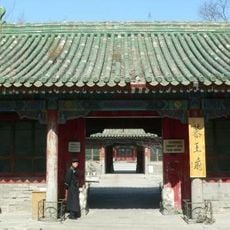
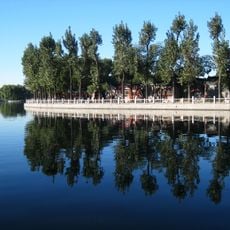
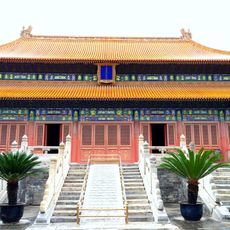
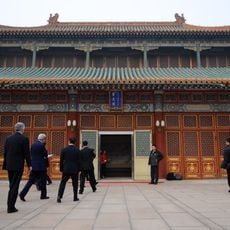
Gold Tortoise Jade Rainbow Bridge, Footbridge in Beihai Park, Beijing, China.
The Gold Tortoise Jade Rainbow Bridge (Jin'ao Yudou Bridge) spans the water between Beihai and Zhonghai at the foot of Tuancheng in Xicheng District, Beijing. It is a stone arch bridge 150 metres long and 8 metres wide with seven arches; the central arch ring bears a relief animal head, and the balustrade posts were originally square with flat tops and lotus finials. Its body resembles a jade belt, a typical Chinese embankment-style stone arch bridge.
The bridge was first built in 1514 during the Ming Jiajing era, when archways inscribed "Jin'ao" and "Yudou" were erected at its ends. In 1954, to ease traffic while preserving Round City, Zhou Enlai ordered the bridge widened toward Zhongnanhai: it grew from 150 to 220 metres, from 7 to 9 arches, and the two archways were moved to Taoranting Park, where they were destroyed during the Cultural Revolution.
The name comes from two Ming-era archways: the west one bore the plaque "Jin'ao" (Gold Tortoise) and the east one "Yudong" (Jade Rainbow). They were removed in 1954 and moved to Taoranting Park, where they were destroyed during the Cultural Revolution. The bridge is still commonly called Beihai Bridge.
The bridge is accessible during regular park hours throughout the year and is easy to navigate on foot. Morning and late afternoon visits offer the best lighting for photography and clearer views of the ornamental details.
The two Ming-era archways that gave the bridge its name, inscribed "Jin'ao" and "Yudou", were removed in 1954 and moved to Taoranting Park, where they were destroyed during the Cultural Revolution. The bridge itself was widened toward Zhongnanhai and lengthened from 150 to 220 metres, with seven arches becoming nine.
The community of curious travelers
AroundUs brings together thousands of curated places, local tips, and hidden gems, enriched daily by 93,107 contributors worldwide.