Pagoda of Monk Wansong, Buddhist memorial pagoda in Jinrongjie Subdistrict, Beijing, China
The Pagoda of Monk Wansong is a 15.9-metre octagonal brick tower of nine storeys with close-set eaves, standing at the east mouth of Zhuanta Hutong off Xisi South Street. Its first storey has false arched doors on four faces and square false windows on the others; the eaves are corbelled brick without bracket sets, and the top ends in a pointed tile roof with a finial and pearl.
The pagoda was built as the tomb pagoda of the Chan monk Wansong Xingxiu (1166–1246) after his death, west of the Jin capital Yanjing. A monk named Le'an found it overgrown in 1606 and raised money for repairs. In 1753 the Qianlong Emperor ordered a restoration carried out under Prince Kang Yong'en, who built a new nine-storey octagonal brick pagoda around the original seven-storey one.
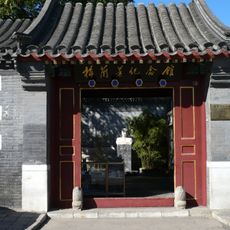
The monk Wansong Xingxiu called himself "Old Man of Wansong" after the Ten Thousand Pine Trees studio where he lived, and the lane beside the pagoda took the name Zhuanta Hutong (Brick Pagoda Lane) from the tower. Since 2014 the courtyard has housed the Zhengyang Bookstore's non-profit reading room, with books on Beijing history and a lending point of the Xicheng Library.
The courtyard is entered from Xisi South Street, a short walk from Xisi Station on Line 4. Pomegranate trees and roses fill the small space, and bookshops on the north and south sides sell titles on Beijing history. An exhibition room displays artefacts and information about the pagoda.
Hidden inside is a completely preserved early structure from the 13th century, surrounded by a much later outer shell. This layered architecture was only fully revealed during modern restoration work.
The community of curious travelers
AroundUs brings together thousands of curated places, local tips, and hidden gems, enriched daily by 93,986 contributors worldwide.