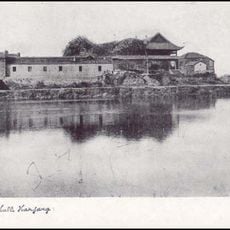
Hanshui railway bridge, Railway bridge in Hanyang and Qiaokou Districts, China.
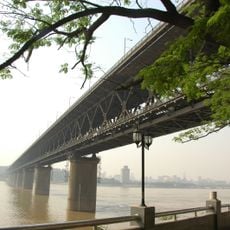
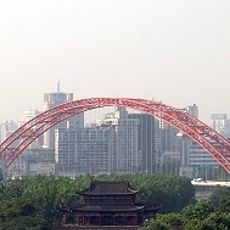
The Hanshui railway bridge is a rail structure spanning the Han River in Wuhan, connecting Hanyang and Qiaokou districts. It carries both freight and passenger trains daily as a key link in central China's rail network.
Construction began in January 1954 as an advance works for the Wuhan Yangtze River Bridge, so that the Beijing–Hankou line could cross the Han River to the Hanyang site; the 300 m bridge opened on 28 December 1954, with the second track following three years later. Its steel came from the Soviet Union, like the Yangtze bridge's, and it was designed to the same standards, initially for 35 km/h. Pile driving in the dense sandy riverbed was the main difficulty, and a dispute between Chinese and Soviet engineers over piling standards was settled only when Li Xiannian intervened.
The bridge is known locally as the Han River Bridge or Han River Iron Bridge. In April 1955, Japanese writer Hino Ashihei visited and noted in his diary that troops guarded the bridge, which was painted a pale ink colour and was still single-track, with one line open and a second planned.
The bridge sits at K1199+410 on the Beijing–Guangzhou line, with approach viaducts of 74.5 m on the Hanyang side and 58 m on the Hankou side. Trains pass at roughly six-minute intervals during maintenance periods, so watch from the riverbanks rather than the track area. The structure is a working railway bridge with no pedestrian deck.
The bridge was built before the Yangtze River Bridge and served as its test piece: both used imported Soviet steel, and the railway spans look alike, earning it the nickname "miniature" or "experimental" bridge. Its piers rest on hollow spun-concrete piles driven 20 to 40 metres into dense fine-sand alluvium.
The community of curious travelers
AroundUs brings together thousands of curated places, local tips, and hidden gems, enriched daily by 94,022 contributors worldwide.