Titisee, Lake in Titisee-Neustadt, Germany
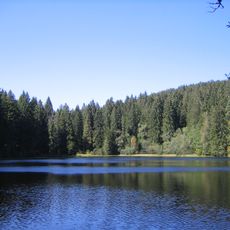
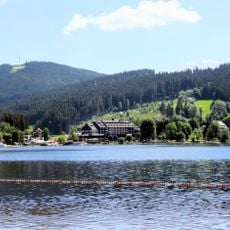
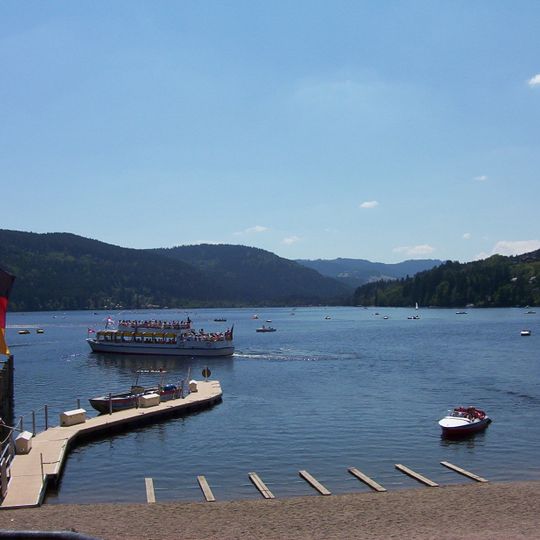
Titisee is a lake in the southern Black Forest, its basin carved by the Feldberg glacier and dammed by Pleistocene moraines that now form its shores. It covers 1.07 km², averages 20 m deep, and lies at 840 m above sea level. The Seebach feeds it, and the Gutach drains it toward the Wutach and the Upper Rhine. The spa town of Titisee-Neustadt sits on the north shore.
The Titisee basin was carved by a glacier that stretched from the Feldberg until about 10,000 years ago; its terminal moraine now dams the meltwater. The lake is first recorded in 1050 as Titinsee in a document of Allerheiligen Abbey, Schaffhausen, and as Dettesee in a 1111 deed from Saig parish. In 1840 two worked tuff sarcophagi were found by the Gutach outflow, dated by archaeologist Andreas Haasis-Berner to 700–900, showing the High Black Forest was settled earlier than assumed.
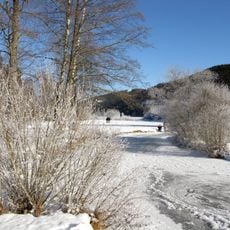
The name comes from a regional legend linking it to the Roman general Titus, though linguists suggest an Alemannic root instead. On summer days families use the lawns along the shore, while winter rarely brings enough cold to make the surface walkable.
A circular path taking about 90 minutes leads around the entire shoreline and offers many access points to the water. Boats and equipment for time at the waterside can be rented at several spots.
In 1840 two sarcophagi of worked tuff were found beneath a knoll by the Gutach outflow; archaeologist Andreas Haasis-Berner dated them to between 700 and 900, overturning the belief that the High Black Forest was unsettled in the first millennium. The lake also holds rare quillworts, Isoëtes echinospora and Isoëtes lacustris, along its shores.
The community of curious travelers
AroundUs brings together thousands of curated places, local tips, and hidden gems, enriched daily by 93,681 contributors worldwide.