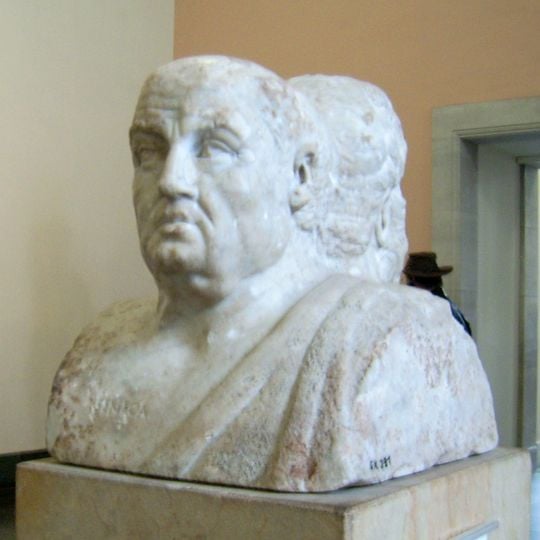
Double Herm of Socrates and Seneca, Marble sculpture in Mitte, Berlin, Germany
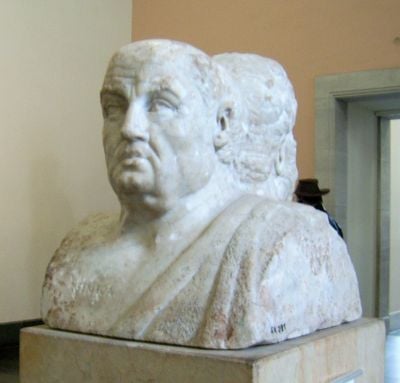
The Double Herm of Socrates and Seneca is a Roman marble sculpture from the first half of the third century AD, carved as a double bust with the two heads joined at the back. The bearded Socrates has a satyr-like face; Seneca is shown clean-shaven with a receding hairline and a small, full-lipped mouth. Both wear the philosopher's cloak over the left shoulder, Socrates also an undershirt. It is held by the Antikensammlung Berlin in the Altes Museum.
The double herm dates from the first half of the third century AD. It was found in 1813 on the Caelian Hill in Rome, on the grounds of the Villa Mattei near the church of S. Maria in Domnica, and was acquired for the Berlin museums in 1878 by Wolfgang Helbig. After the Second World War it stood in the Pergamon Museum until the two Berlin antiquities collections were reunited after reunification; since then it has been shown in the Altes Museum on the Lustgarten.
The sculpture shows two different thinkers side by side, each representing distinct philosophical paths. Visitors can see how Romans brought together Greek and their own intellectual traditions on the same piece.
The work is relatively small and requires close viewing to see all its details. Take time to observe the inscriptions and compare the differences between the two portrait faces.
The Latin inscription identifying Seneca sits on the side of the bust to his own right, while Socrates is named in Greek on the other side. Because this is the only portrait that can be securely identified as Seneca, it serves scholars today as the reference for recognising his face in other ancient works.
The community of curious travelers
AroundUs brings together thousands of curated places, local tips, and hidden gems, enriched daily by 93,289 contributors worldwide.