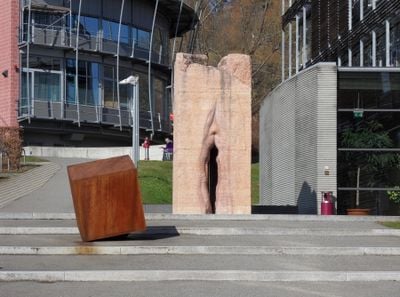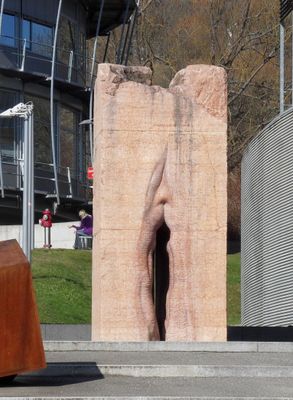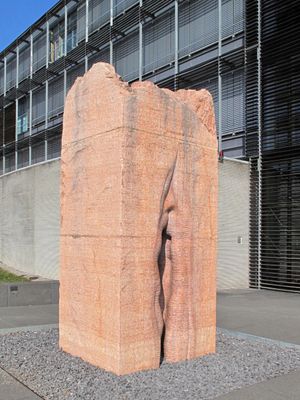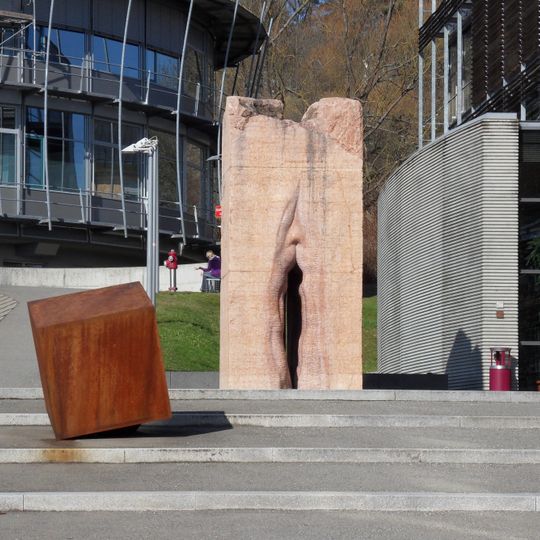
Pi-Chacán, red Verona marble sculpture at the University of Tübingen, Germany
Pi-Chacán is a 4.2-metre-tall block of red Verona marble carved by Fernando de la Jara, weighing 32 tons. Its front face has a deep vertical cleft that widens into a rounded opening, and the rough top edge is broken. A narrow slit cut into the back lets light into the hollow interior. It stands on the Schnarrenberg campus of the University of Tübingen.
Fernando de la Jara created Pi-Chacán in 2001 for the University of Tübingen's Institute for Microbiology and Virology on the Schnarrenberg. The 32-ton block of red Verona marble cost €120,000; a planned pool at its base was omitted for budgetary reasons. It stands at the end of the Weg der Künste, facing the entrances of the Anatomy, Microbiology and Virology buildings.
The name combines Quechua and Greek: chacán means, according to the artist, "place where the action of water has tunneled through a large rock or a mountain" or "lovemaking", while pi is the Greek letter and mathematical symbol π, chosen because it resembles a door or a vulva. De la Jara called the work a "gate to the world" and intended it as tactile, participatory art that "should be entered".
The sculpture stands outdoors on the Schnarrenberg campus, at the end of the Weg der Künste facing the entrances of the Anatomy, Microbiology and Virology buildings. It rests directly on a grassy surface, so it can be walked around and viewed from all sides; the cleft opens toward the front, with a narrow slit cut into the back that lets light into the hollow interior.
In 2014, firefighters rescued an American exchange student trapped inside the sculpture while attempting an unusual photograph. This incident reveals how the work's openings draw visitors to engage with it in unexpected ways.
The community of curious travelers
AroundUs brings together thousands of curated places, local tips, and hidden gems, enriched daily by 92,646 contributors worldwide.