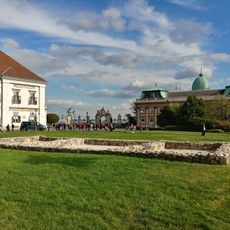
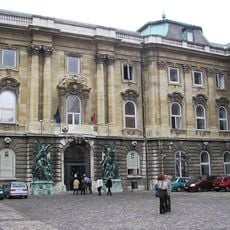
Carmelite Monastery of Buda, Former baroque monastery in Castle District, Budapest, Hungary.
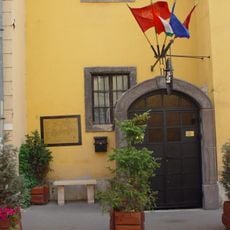
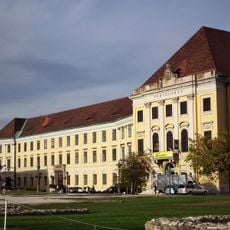
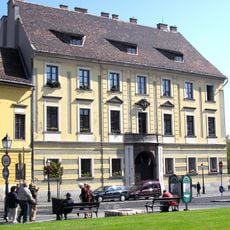
The Carmelite Monastery of Buda is a late-Baroque complex in the Castle Quarter of Budapest, at Színház utca 5–7. It consists of the Carmelites' former two-storey convent with an enclosed courtyard and, attached to its southern side, a single-nave church building. The complex was built between 1725 and 1736; the church tower was later demolished when the church was converted into a theatre.
Construction of the monastery took place between 1725 and 1736 on land that previously held St. John's Church, making it a center for the Carmelite order. Following Joseph II's decree in 1787, the building was repurposed as a theater.
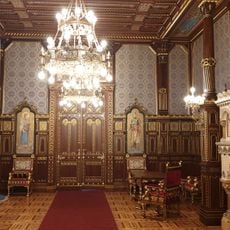
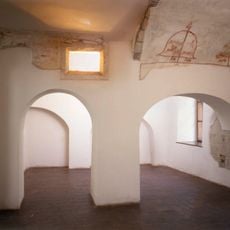
The former refectory was remodelled by Wolfgang von Kempelen into a ceremonial hall, decorated with Ferenc Gelinek's neoclassical wall paintings of flower garlands and medallions. The building's name survives in everyday use as Karmelita, or simply Karmelita kolostor, after the Carmelite order that held the site from 1693.
The complex stands at Színház utca 5–7 in the Castle Quarter, with the former church wing facing Színház utca 1–3. Since May 2026 it has opened to the public, and visits are possible at weekends. The Carmelite order's former residence is the two-storey wing around the inner courtyard.
Kempelen's 1786 conversion plan included three bowling alleys and three so-called Lusthaus pavilions in the former monastery, and proposed a theatre floor that could be raised for carnival balls; the ballroom idea was never built. The crypt beneath the sanctuary became the trap room, and the monks' cells served as changing rooms.
The community of curious travelers
AroundUs brings together thousands of curated places, local tips, and hidden gems, enriched daily by 93,022 contributors worldwide.