Salimgarh Fort, Historic fort in Central Delhi, India
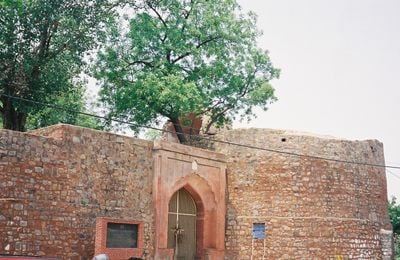
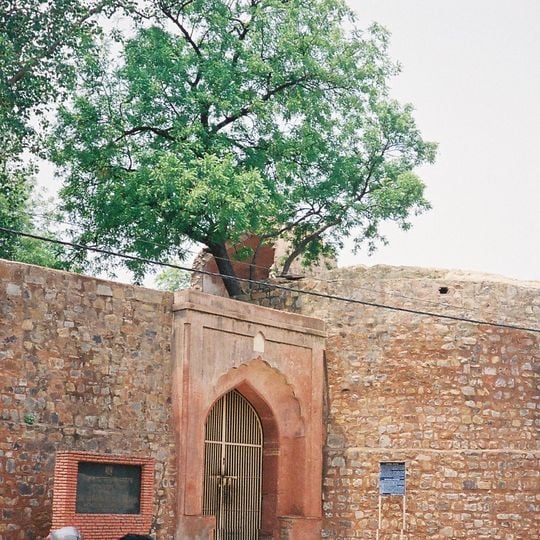
Salimgarh Fort is a triangular fortification with thick walls of rough, irregular reddish-brown rubble masonry and circular bastions. A red sandstone gateway topped by a pointed, scalloped arch stands in the centre, holding a metal gate of vertical bars; a rectangular red sandstone panel with a dark inscribed plaque sits low in the wall to its left. An arch bridge, the Bahadur Shah Gate, links it to the Red Fort on the northeastern side.
Salimgarh Fort was built in 1546 by Salim Shah Suri, son of Sher Shah Suri, on an island of the Yamuna during the Sur interregnum. After Humayun retook Delhi in 1555, he renamed it Nurghar and forbade use of its original name at court. Aurangzeb converted it into a prison, holding his brother Murad Baksh and, reportedly, his daughter Zebunnisa for 21 years. The British continued its use as a prison after 1857 and later held INA prisoners there from 1945.
Aurangzeb first turned Salimgarh into a prison, holding his brother Murad Baksh there after his capture at Mathura, before sending him to Gwalior for execution. He is also said to have confined his eldest daughter Zebunnisa, a poet and music lover, in the fort for 21 years until her death. From 1945 the British used it to detain Indian National Army prisoners.
The fort is accessible on foot from the Red Fort via a pedestrian bridge connecting the two sites, making it easy to visit both in one trip. Wear sturdy footwear as the paths are uneven, and conditions can become slippery during or after rain.
The fort's walls are rubble masonry, not brick: rough, irregular reddish-brown stones with red sandstone used for the central gateway and its scalloped arch. The gate's metal bars and the inscribed plaque set into the wall beside it are details visitors often pass without noticing.
The community of curious travelers
AroundUs brings together thousands of curated places, local tips, and hidden gems, enriched daily by 93,860 contributors worldwide.