Hemis Monastery, Tibetan Buddhist monastery in Leh district, India
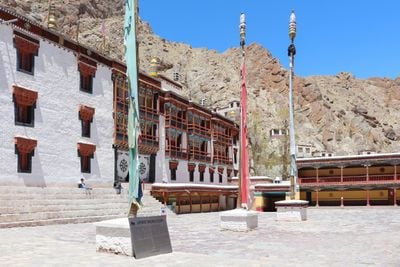
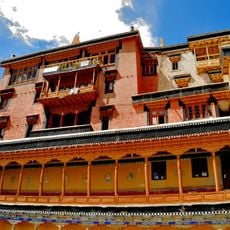
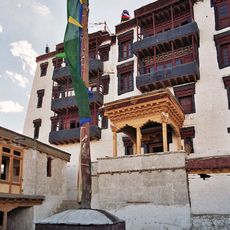
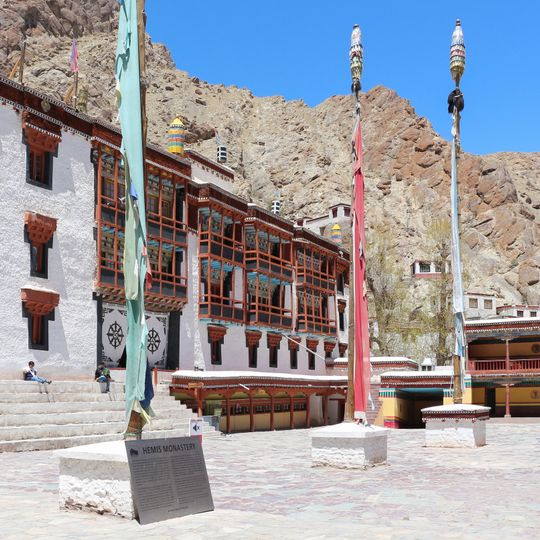
Hemis is a whitewashed Drukpa-lineage gompa on a raised platform above the Indus, 45 km from Leh. Red horizontal bands divide its facade, whose tall windows have dark brown wooden frames with orange and blue surrounds; patterned blue and yellow valances shade the rows of windows. Two small red-trimmed oriel windows sit above a black panel bearing a white eight-spoked wheel, and a grey stone monument in front reads "HEMIS MONASTERY".
Hemis Monastery existed before the 11th century; the Tibetan masters Naropa, Tilopa and the translator Marpa are said to have had links with it. In the 17th century the Ladakhi king Sengge Namgyal re-established the gompa, which belongs to the Drukpa Lineage. In 1894 the Russian journalist Nicolas Notovitch claimed a Life of Saint Issa was kept in its library, a story scholars regard as a hoax.
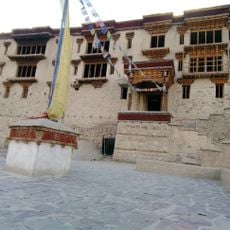
The Hemis Festival, or Hemis tshe-bcu, honours Padmasambhava, believed born on the tenth day of the fifth Tibetan month. Monks perform chams mask dances in the courtyard before the main door, among two raised square platforms three feet high with a sacred pole at the centre. Musicians play four pairs of cymbals, large-pan drums, small trumpets and large wind instruments.
The monastery museum displays religious artifacts, statues, and ancient thangka paintings, with guided tours led by resident monks. Visitors should wear comfortable shoes and allow time for the steep terrain.
In 1894 the Russian journalist Nicolas Notovitch claimed that a life of Jesus, the Life of Saint Issa, had been kept in the Hemis library and shown to him by monks while he recovered from a broken leg; scholars now treat the story as a hoax. Swami Abhedananda later said he read the same manuscript in 1921, and after his death monks told a disciple the documents had disappeared.
The community of curious travelers
AroundUs brings together thousands of curated places, local tips, and hidden gems, enriched daily by 94,076 contributors worldwide.