Mubarak Mandi Palace, Royal palace in Jammu, India
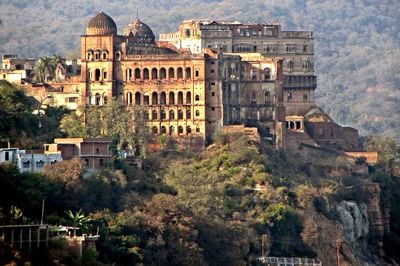
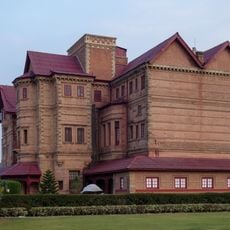
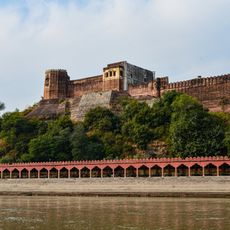
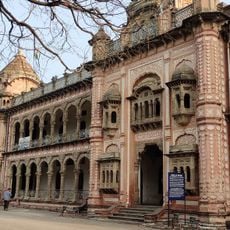
Mubarak Mandi Palace is a multi-storey complex of reddish-brown brick and stone on a terraced hillside above the Tawi River in Jammu. Its upper storeys show rows of deep-set arched galleries, while lower walls carry white plaster peeling away to expose brick. Two dark ribbed domes with pointed finials sit on a blocky base at one end, and a large arched gateway opens through the lower walls.
Raja Dhruv Dev moved his residence to this site above the Tawi River in 1710, as recorded in the Rajdarshani chronicle; his son Ranjit Dev added buildings. In 1783 the Sukerchakia Misl attacked Jammu and burned large parts of the palace. Maharaja Ranbir Singh carried out major renovations in 1874, and Rani Charak Palace was built in 1913 under Pratap Singh. The maharajas kept their seat here until 1925, when Hari Singh moved to Hari Niwas Palace.
Part of the complex houses the Dogra Art Museum, whose collection includes miniature paintings, royal artefacts and manuscripts. The museum is not in a "Pink Hall": the Pink Palace is a separate building of the complex. The palace was the Dogra dynasty's seat of power and ceremony until 1925, when Maharaja Hari Singh moved to Hari Niwas Palace.
The palace is easily accessible from Jammu city center, with guided tours available through the preserved sections of the complex. Wear comfortable shoes as you navigate multiple levels and staircases throughout your visit.
The Dogra Art Museum occupies part of the complex and holds miniature paintings, royal artefacts and manuscripts from the Dogra court. The palace itself was attacked and set ablaze by the Sukerchakia Misl in 1783, and over its history it has survived more than 36 destructive fires.
The community of curious travelers
AroundUs brings together thousands of curated places, local tips, and hidden gems, enriched daily by 93,862 contributors worldwide.