Plinths of Yeongeunmun Gate, Seoul, Stone foundation remnants in Seodaemun District, South Korea.
The Plinths of Yeongeunmun Gate are the stone bases that supported Yeongeunmun, a gate built in 1537 and named in 1539 to honor Joseon's hospitality toward Chinese envoys. The gate itself was demolished in 1895, leaving only these plinths, now set within Seodaemun Independence Park in Seoul.
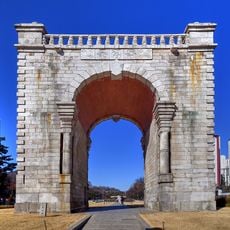
Yeongeunmun was built in 1537 and named in 1539 to honour Joseon's hospitality toward Chinese envoys, whom the king received with the three-kowtow rite. In February 1895 Prime Minister Park Yung-hyo proposed its demolition to end the Sadae policy; the gate was destroyed and its plinths kept as a memorial. Dongnimmun was later built above them.
The foundation stones reflect a moment when Korea reshaped its diplomatic relationships and asserted its own identity beyond Chinese influence. Walking among these remains helps visitors understand how architecture can mark such pivotal shifts in a nation's direction.
The foundation stones are located within Seodaemun Independence Park near the Independence Gate, making them easy to find alongside other historical points of interest. Since the remains are relatively small and open to view, visitors can spend as little or as much time as they wish exploring the site.
The plinths and Dongnimmun were together designated Historic Site No. 33 on 21 January 1963. In 1979–1980 both were moved 50–70 metres north to make way for road widening, keeping Soh Jaipil's arrangement in which the Independence Gate looks down on the old plinths.
The community of curious travelers
AroundUs brings together thousands of curated places, local tips, and hidden gems, enriched daily by 93,480 contributors worldwide.