Mansouri Great Mosque, 13th century mosque in Tripoli, Lebanon
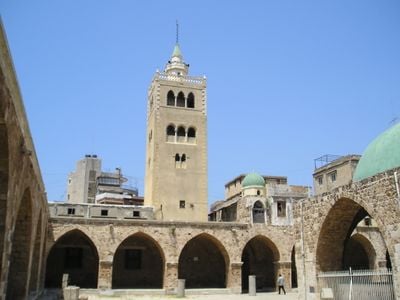
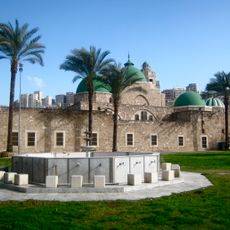
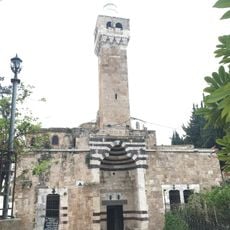
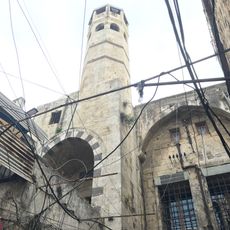
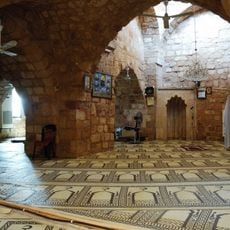
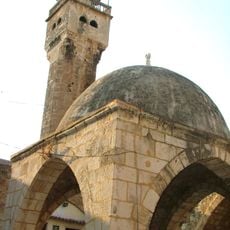
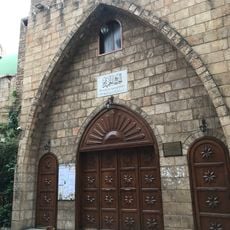
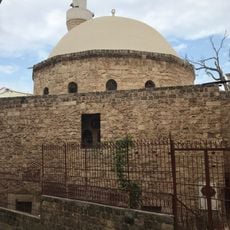
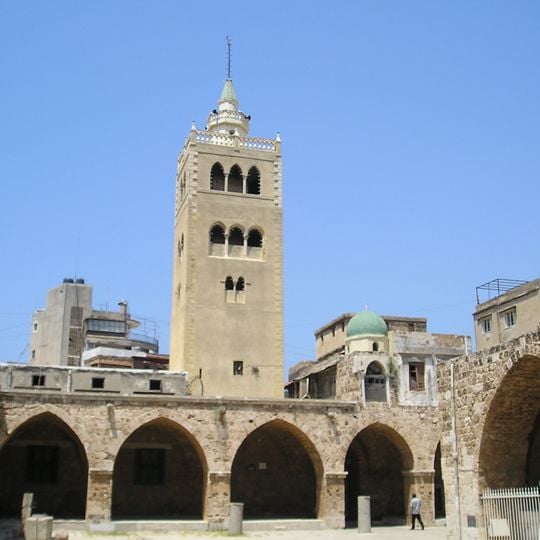
The Mansouri Great Mosque covers about 50 by 60 metres in Tripoli's an-Nuri neighbourhood. Its northern gate and pale-tan minaret, with paired arched openings and a small green-roofed balcony, are Crusader remains; the courtyard, arcades and prayer hall are Mamluk. Two granite columns stand to the right of the main entrance.
Begun in 1294 under Sultan al-Ashraf Khalil, five years after his father al-Mansur Qalawun took Tripoli from the Crusaders, the mosque was the first Mamluk building in the city. Al-Nasir Muhammad added the courtyard arcades in 1314. Its northern gate and minaret tower are remains of the Crusader church of Mary of the Tower, damaged by earthquakes in 1170 and 1201 and by the 1289 siege.
The mosque takes its name from Sultan al-Mansur Qalawun, who took Tripoli from the Crusaders in 1289, though his son al-Ashraf Khalil ordered the building in 1294. In the western portico a room holds a hair of the Prophet Muhammad, given to the city by Ottoman Sultan Abdul Hamid II in 1889 or 1890, and a sheikh was appointed to care for it.
The mosque sits below the level of the surrounding streets, so you descend to it by stairs: two flights at the main northern gate and steps at the two eastern doors. The courtyard is entered through three axial gates, north, east and west, with two more flanking the prayer hall. The ground outside is higher on the south side.
In the western portico a room built in 1890 holds a relic donated by Ottoman Sultan Abdul Hamid II: a hair from the Prophet Muhammad, recorded in Tripoli's sharia court registers. A Sheikh, Muhammad Rashid Afandi al-Miqati, was appointed to care for it.
The community of curious travelers
AroundUs brings together thousands of curated places, local tips, and hidden gems, enriched daily by 94,048 contributors worldwide.