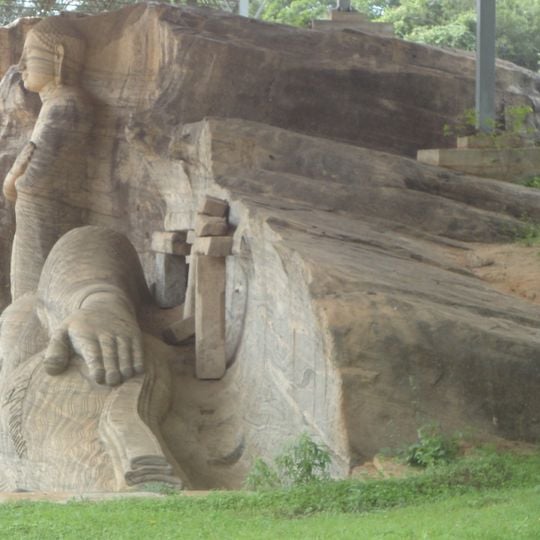
Gal Vihara, Buddhist rock temple in Polonnaruwa, Sri Lanka
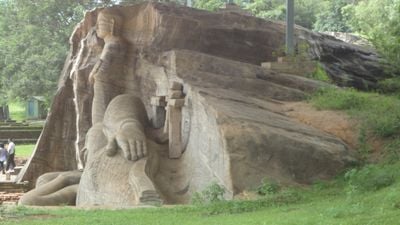
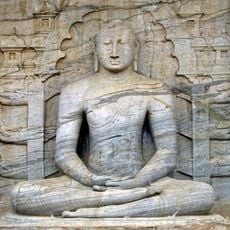
Gal Vihara is a Buddhist temple in Polonnaruwa, Sri Lanka, with four Buddha statues carved from the same granite rock. The complex lies at the edge of a forest area and shows, besides the reclining figure, three other representations in seated or standing postures.
King Parakramabahu I (1153–1186) had the rock face cut back and the Uttararama built in the 12th century, as recorded in the Cūḷavaṃsa. He convened monks there to reconcile the three fraternities and had a code of conduct inscribed on the polished rock between the cave and the standing image. The site was abandoned when the Kingdom of Polonnaruwa fell. In 1820 the British officer Fagan first introduced it to Western audiences.
The name Gal Vihara, 'rock monastery', came into popular use only in the 20th century; the original name was Uttararama, 'northern monastery'. The standing figure is identified by some scholars and local stories as the monk Ananda, while others see the Buddha. The polished rock face between the cave and the standing image carries Parakramabahu I's inscribed code of conduct for monks.
Visitors must remove their shoes before stepping onto the platform in front of the sculptures and keep their shoulders covered. The temple area lies somewhat secluded within the archaeological park, so a bicycle or tuk-tuk makes exploring easier.
The standing figure carries arms crossed over the chest, a gesture that some researchers attribute to the disciple Ananda rather than the Buddha himself. Originally, a small brick shelter stood in front of each image, but these have now disappeared.
The community of curious travelers
AroundUs brings together thousands of curated places, local tips, and hidden gems, enriched daily by 93,467 contributors worldwide.