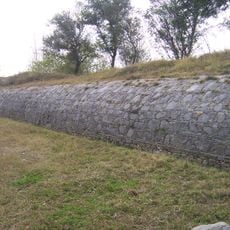
Tarbela Dam, Earth-fill dam near Islamabad, Pakistan.
The Tarbela Dam extends more than two kilometers across the Indus valley in Khyber Pakhtunkhwa province and rises 143 meters above the riverbed. The facility consists of a massive earth-fill structure and a large reservoir that stretches upstream between the mountains.
Tarbela Dam was built as part of the Indus Basin Project after the 1960 Indus Waters Treaty, to replace water lost when the eastern rivers were assigned to India. The site was chosen in 1952 after fourteen years of study; the World Bank approved construction in 1967 and the Italian firm Salini Impregilo built it in three stages, completed in 1976. In 1974–75 tunnel damage during first filling delayed impoundment.
The name Tarbela comes from Pashto and refers to the earlier settlement at this point on the Indus. Today you see fishing boats on the reservoir and farmers use the canals along the shores to grow wheat and rice.
The facility sits about 50 kilometers northwest of Islamabad and is accessible by road from Haripur. Access to the dam wall itself is restricted, but you can view the reservoir and surrounding hills from several vantage points nearby.
The main powerhouse on the right bank holds seventeen generators fed by outlet tunnels 1 to 4: four 175 MW units on tunnel 1, six 175 MW on tunnel 2, four 432 MW on tunnel 3 and three 470 MW on tunnel 4, giving 4,888 MW in total. Over 70% of the water released at Tarbela passes over the spillways without generating power.
The community of curious travelers
AroundUs brings together thousands of curated places, local tips, and hidden gems, enriched daily by 93,109 contributors worldwide.