Thousands buddhas cliff, Buddhist rock carvings in Guangyuan, China
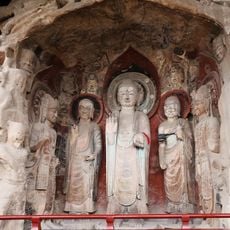
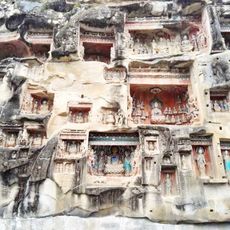
Thousands Buddhas Cliff is a 388.8-metre-long stretch of rock carvings on the east bank of the Jialing River, 5 km north of Guangyuan. It holds 848 niches and over 7,000 statues, with the Great Buddha Cave, Three Saints Hall, Hidden Buddha Cave, Lotus Cave and Thousand Buddha Cave among the main groups.
Carving began in the late Northern Wei period (386–534) and continued through the Sui, Tang, Song, Yuan and Ming dynasties, most of the work dating from the Tang (618–907). No new figures were cut after the Qing dynasty. The site was listed as a Major Historical and Cultural Site Protected at the National Level on 4 March 1961.
The name Qiānfúyá, "Cliff of a Thousand Buddhas", refers to the dense carving of figures along the Jialing's east bank. The main niches visitors look for are the Great Buddha Cave, the Three Saints Hall, the Hidden Buddha Cave, the Lotus Cave and the Thousand Buddha Cave. No new figures were carved after the Qing dynasty.
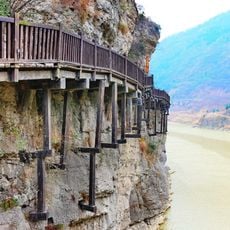
The carvings run north-south along the east bank of the Jialing River, 5 km north of Guangyuan's centre and near Huangze Temple, so the two sites are easily combined. The cliff is 200 m long and 45 m high; the main caves, including the Great Buddha Cave and the Thousand Buddha Cave, are reached by paths and stairs along the rock face.
The cliff runs 388.8 metres north to south along the east bank of the Jialing River, 5 km north of Guangyuan's centre near Huangze Temple. Of more than 17,000 original statues, most were destroyed in 1936 during construction of the Sichuan-Shaanxi highway; 848 niches and over 7,000 figures remain, including the Great Buddha Cave, Three Saints Hall, Lotus Cave and Thousand Buddha Cave.
The community of curious travelers
AroundUs brings together thousands of curated places, local tips, and hidden gems, enriched daily by 93,454 contributors worldwide.