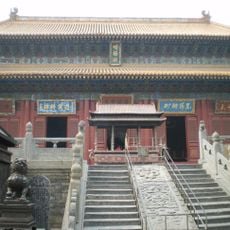
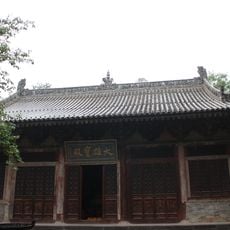
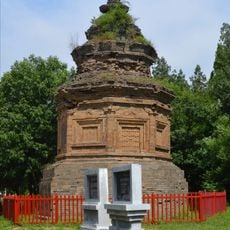
Pagoda of Yongtai Temple, Buddhist temple pagoda in Dengfeng, China.
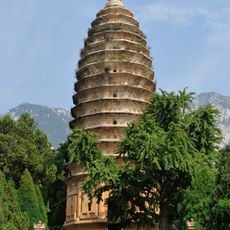
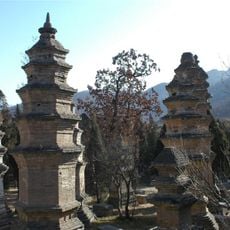
The Pagoda of Yongtai Temple is a Tang-dynasty brick pagoda of the dense-eave type, with eleven storeys and a square plan measuring 5.05 metres along each base side; it rises 24 metres. It stands at the western foot of Mount Song in Dengfeng, Henan, within a temple site whose other ancient survivals are two smaller brick pagodas and inscriptions.
The temple was founded in 521, the second year of the Zhengguang era of the Northern Wei, under the name Minglian Temple. In 706, the second year of the Shenlong era of the Tang, it was renamed Yongtai Temple. Of the ancient complex only the Tang brick pagoda, two smaller pagodas of 1209 and 1638, and inscriptions survive; the rest is modern reconstruction.
The temple was founded in 521 as Minglian Temple and renamed Yongtai Temple in 702, during the Tang dynasty. Besides the Tang brick pagoda, the grounds keep two later brick tombs: the Jun'an master's tower of 1209, over 3 m tall, and the lama-style Purification and Equanimity Pagoda of 1638, 6.18 m high. Inscriptions also survive.
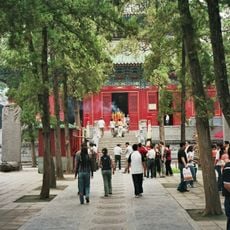
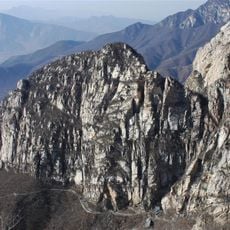
The Tang pagoda, the Jin Jun'an Pagoda and the Ming Purification and Equanimity Pagoda stand together on the temple grounds at the western foot of Mount Song in Dengfeng's Shaolin Subdistrict, so the three can be compared in one walk. The temple itself is largely a modern reconstruction; the pagodas and inscriptions are the original survivals.
The temple grounds hold three pagodas from different eras: the Tang brick pagoda, the Jin-era Jun'an Zhuta of 1209, and the Ming Purification and Equanimity Pagoda of 1638. The last is a 6.18-metre lama-style brick tower, showing Tibetan Buddhist influence reaching this Songshan site in the late Ming.
The community of curious travelers
AroundUs brings together thousands of curated places, local tips, and hidden gems, enriched daily by 94,139 contributors worldwide.