Songyue Pagoda, Brick pagoda in Dengfeng, China
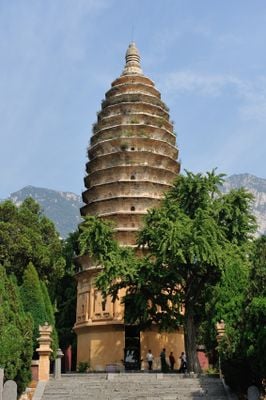
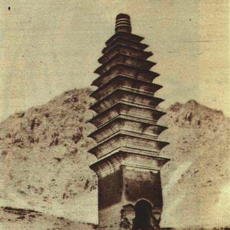
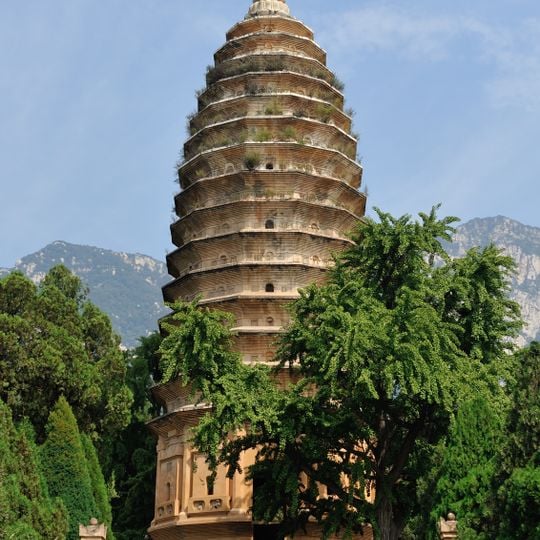
Songyue Pagoda is a twelve-sided brick tower rising 39.8 meters from a stone platform on the southern slope of Mount Song. Its lower storey has arched doors on four sides and eight niches carved with lions and lotus motifs; above, fifteen closely stacked eaves taper to a finial with two hidden reliquary chambers. The tan and grey brickwork shows weathering and small plants along the tier edges.
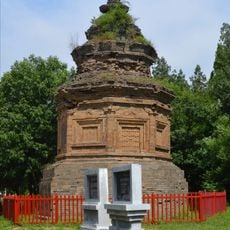
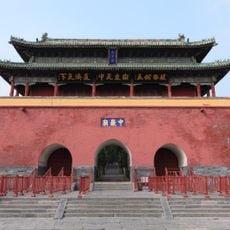
The pagoda was built in 523 CE at the Xianju Monastery, which became Songyue Monastery in 602 under Emperor Wen of Sui, when the tower received its present name. After the Tang dynasty, Buddhist activity moved to Shaolin Monastery and Songyue fell into disuse, leaving only the pagoda and the temple gate. It was listed as a National Key Cultural Relic in 1961 and joined the UNESCO World Heritage Site "The Centre of Heaven and Earth" in 2010.
The pagoda's name comes from Songyue Monastery, which was renamed in 602 CE under Emperor Wen of Sui; the tower itself was built in 523. Its twelve-sided plan is the only one among Chinese multi-eaved pagodas. The eight faces without doors carry brick niches shaped like miniature pagodas, and the door pillars have lotus-flower bases and capitals carved with pearls and lotus blooms.
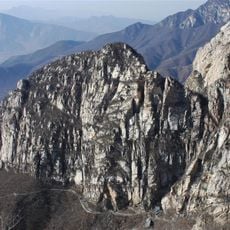
Located at the southern foot of Mount Song, the pagoda can be examined from various vantage points around its exterior. Visitors should allow time to explore the different levels and observe the carved details that cover the outer walls.
The underground palace beneath the pagoda was found only in 1985–1986, during surveys before restoration, and cleared in 1988. Its stone door lintel carries a pomegranate carved in relief with paired phoenixes, and the side jambs bear seated monk figures inscribed "Bhiksu Chongtai" (west) and "Bhiksu Rukong" (east).
The community of curious travelers
AroundUs brings together thousands of curated places, local tips, and hidden gems, enriched daily by 92,796 contributors worldwide.