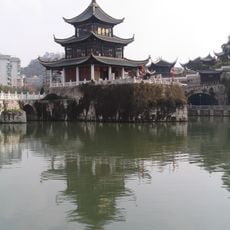
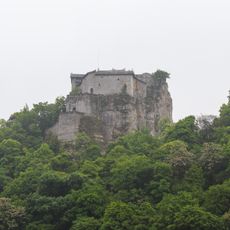
Wenchang Pavilion, Historical pavilion in Yunyan District, China.
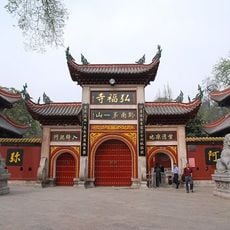
Wenchang Pavilion stands inside the old Wusheng Gate crescent wall in Yunyan District, Guiyang. The 17.25-metre wooden tower has three eaves and a nine-sided pyramidal roof; its lower storey is nearly square while the upper two are irregular nonagons. It faces west, backed by the city wall, with side wings and an entrance hall around a courtyard of about 1,200 square metres.
Wenchang Pavilion was first built in 1596, the 24th year of the Ming Wanli reign, inside the crescent wall of Wusheng Gate, the east gate of Guiyang's Ming city. Destroyed in 1664, it was rebuilt in 1669 under governor Gan Wenkun and巡抚 Tong Fengcai, then repaired repeatedly in 1692, under Yongzheng, in 1741, 1799 and 1842. An 1818 earthquake tilted the structure, and repairs followed in 1821.
The pavilion's name refers to Wenchang, the god of literature and scholarship, and its three levels housed Kui Xing, Wenchang Dijun and Guan Yu. Three Qing couplets restored in 1983 include Zhang Guangsi's line '盛世车书环斗极,遐方文物应奎垣'. A plaque reading '天下之母', made in 1895, hints that other deities were once worshipped here.
The pavilion sits on Wenchang Street in the city center and is easy to reach on foot. Visitors should prepare for steep stairs inside, as the traditional structure has no modern elevators.
The nine-sided plan was laid out by dividing a circle into four quarters, then splitting the front arc into three and the other three arcs into two. The design echoes the number nine throughout: 81 beams, 54 columns and nine joists on each upper storey. Only one other pavilion in Guizhou, the Wengqi Kuiven Pavilion in Dushan County, shares this plan.
The community of curious travelers
AroundUs brings together thousands of curated places, local tips, and hidden gems, enriched daily by 93,737 contributors worldwide.