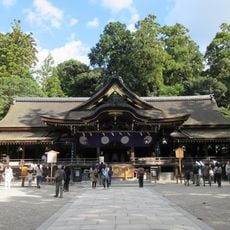
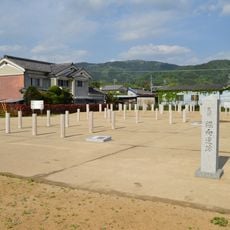
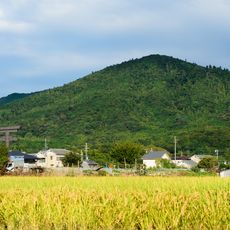
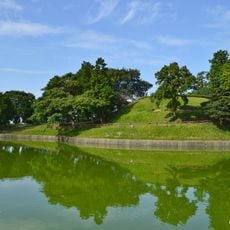
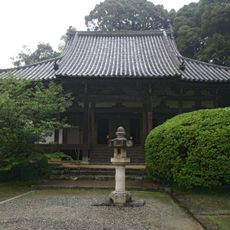
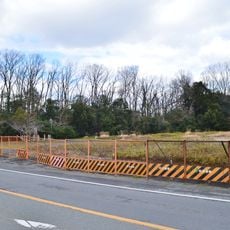
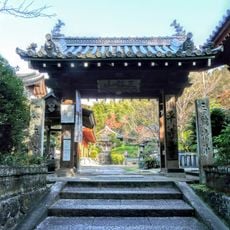
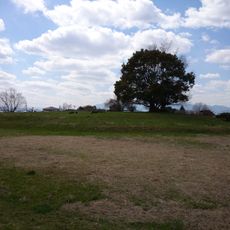
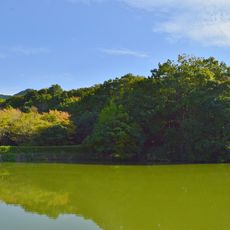
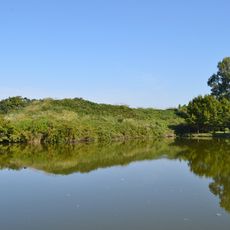
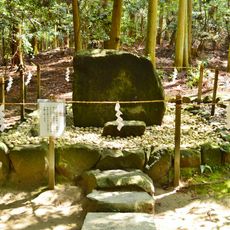
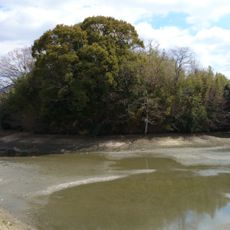
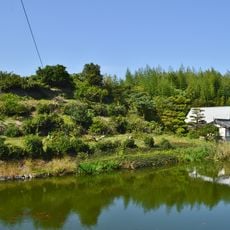
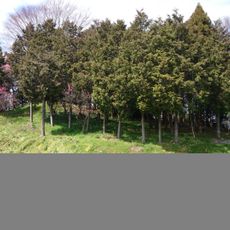
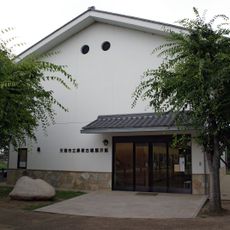
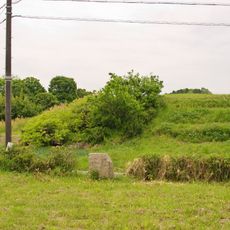
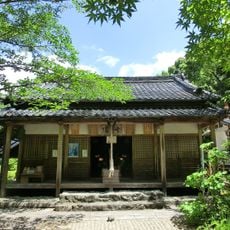
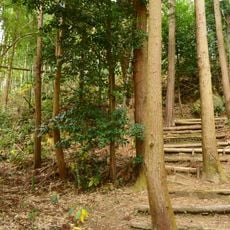
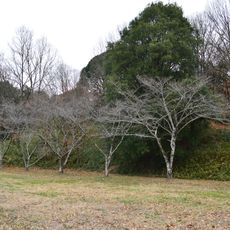
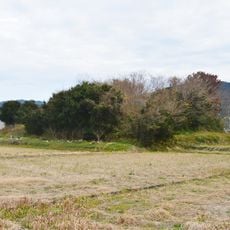
Shibutani Mukaiyama Kofun, Imperial mausoleum in Tenri, Japan.
Shibutani Mukaiyama Kofun is a keyhole-shaped mound in Shibutani-cho, Tenri, Nara Prefecture, with a 300-meter length, a 168-meter-diameter rear circle, and a 170-meter-wide front section. Built on a slope where the ridge from Mount Ryuo flattens, its front faces west; the rear circle has four terraces and the front three. A moat divided by ten causeways surrounds it.
In the Edo period the mound was first identified as Emperor Sujin's tomb; in 1864 it was repaired and a jasper stone pillow, now a National Important Cultural Property, came to light. Just before the repairs finished in 1865 it was re-designated as Emperor Keiko's mausoleum, and the Meiji government kept that attribution. Excavations by the Imperial Household Agency followed in 1971, 1993 and 2015, and in 2016 representatives of 15 scholarly societies were admitted.
The name Shibutani comes from the locality in Tenri where the mound stands; the Imperial Household Agency designates it Yamanobe-no-Michi-no-E no Misasagi, the tomb of Emperor Keiko, a name shared in the Kojiki and Nihon Shoki with the tomb of Emperor Sujin. The Yamato Sanzan ridge path, the Yamanobe-no-Michi, runs past the rear circular end, and the surrounding slopes keep old stone-paved stretches of this route.
The site is managed and strictly protected by the Imperial Household Agency, with designated boundaries that regulate access. Visitors should note the marked areas and respect the solemn nature of the location.
The mound sits at a slope break on a ridge running west from Mount Ryuo, not on flat ground; its moat is divided by ten causeways because of the sloping terrain. The rear circle's moat keeps its original shape, while the front section's was enlarged in the early modern period as a farm pond.
The community of curious travelers
AroundUs brings together thousands of curated places, local tips, and hidden gems, enriched daily by 93,664 contributors worldwide.