Downing Street Historic District, Tudor Revival district in Hollister, US.
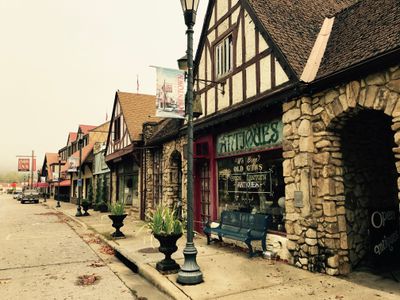
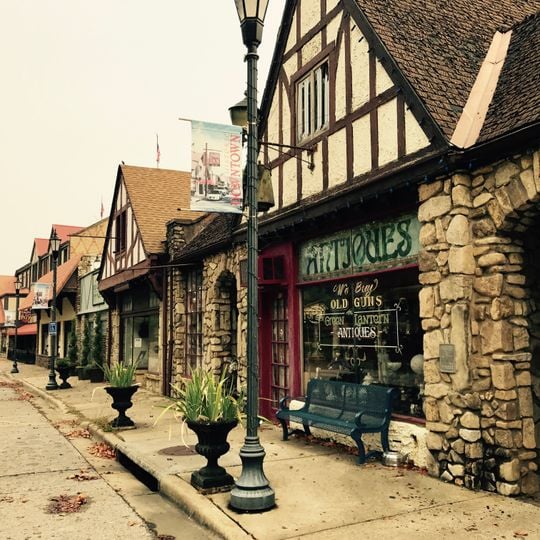
The Downing Street Historic District, known as The English Village, is a planned group of 12 contributing buildings in Hollister, Missouri, built between 1909 and the 1920s in the Tudor Revival style. Their walls are stone and stucco in light beige, with decorative boards painted dark brown. Among them are the U.S. Post Office–Gwinn Ceramics, the Christian Science Society, Ye Old English Inn and Hollister City Hall, formerly the Missouri Pacific Railroad Depot of 1910.
The buildings were constructed between 1909 and the 1920s as a planned community inspired by European architecture. The district received recognition on the National Register of Historic Places in 1978.
The district is nicknamed "The English Village" for its Tudor Revival buildings, a style that draws on English half-timbering rather than colonial or Elizabethan models. The dark brown boards against light beige stone and stucco are the detail to look for on each facade. Notable buildings include the Christian Science Society, Ye Old English Inn and the former Missouri Pacific Railroad Depot of 1910, now Hollister City Hall.
The district sits between 3rd and 4th Streets and is easy to explore on foot at a leisurely pace. You can view all the buildings and their details without needing special equipment or reservations.
The district's 12 contributing buildings were erected between 1909 and the 1920s as a planned village in the Tudor Revival style, with light beige stone and stucco walls and dark brown decorative boards. Among them are the U.S. Post Office–Gwinn Ceramics, the Christian Science Society, Ye Old English Inn and Hollister City Hall, formerly the Missouri Pacific Railroad Depot of 1910.
The community of curious travelers
AroundUs brings together thousands of curated places, local tips, and hidden gems, enriched daily by 92,821 contributors worldwide.