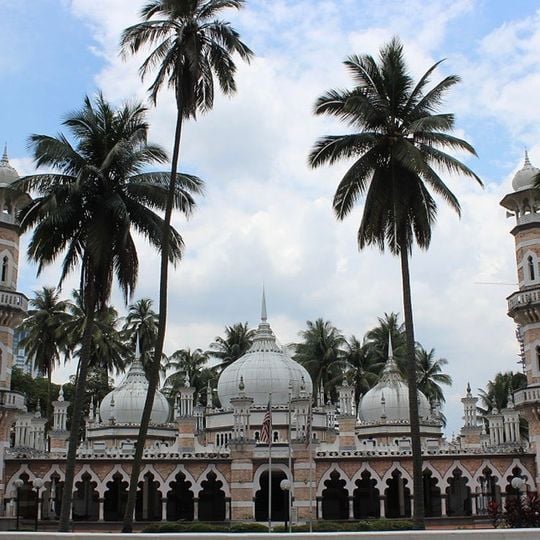
Sultan Abdul Samad Jamek Mosque, Islamic mosque at Klang River confluence, Kuala Lumpur, Malaysia
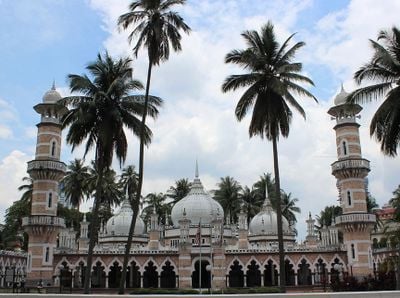
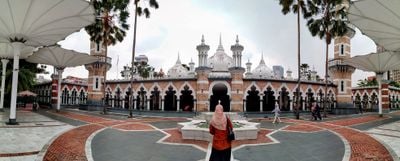
The Sultan Abdul Samad Jamek Mosque stands at the confluence of the Klang and Gombak rivers. Its pale stone facade has a row of pointed arches, alternately open and grille-filled, framed by columns with carved capitals. Above runs a band of white and reddish-brown stonework; three clustered white domes with grey vertical banding and slender spires top the roofline, with three tiered minaret-like towers between them. A low octagonal fountain basin sits before a short staircase.
Arthur Benison Hubback, a British architect working for the colonial administration, designed the building in 1909 using forms borrowed from Mughal India and Moorish Spain. This was the first brick structure of its kind in the country and served as the main Friday congregation point until a larger facility opened in 1965.
Locals call it the "Friday Mosque", and "Jamek" is the Malay form of the Arabic jāmiʿ, a place where people congregate to worship. The mosque was renamed Sultan Abdul Samad Jamek Mosque on 23 June 2017 by Sultan Sharafuddin Idris Shah, after his ancestor, the fourth Sultan of Selangor.
Visitors should plan around morning and afternoon windows that pause during midday prayers, which follow the Islamic schedule. Modest clothing is expected, and those without long sleeves or trousers can borrow robes from the entrance to meet the dress code.
The mosque stands on the site of an old Malay burial ground at the meeting of the Klang and Gombak rivers; the graves were moved before construction, and the nearby Kampung Rawa mosque was later demolished. Worshippers once performed ablutions at the river confluence, reaching the water by steps built into the bank.
The community of curious travelers
AroundUs brings together thousands of curated places, local tips, and hidden gems, enriched daily by 92,544 contributors worldwide.