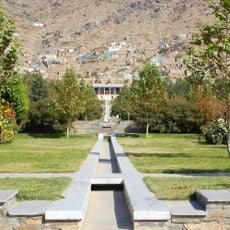
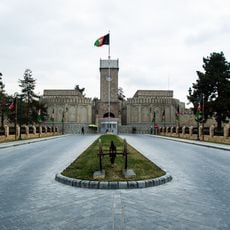
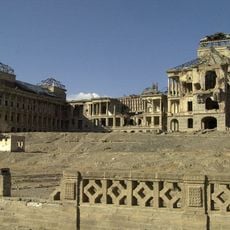
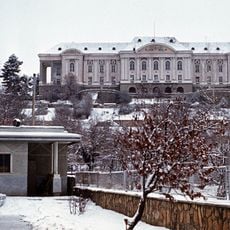
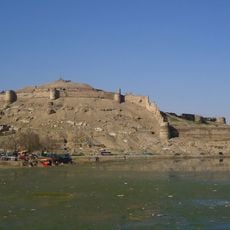
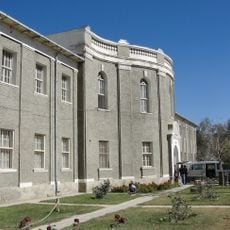
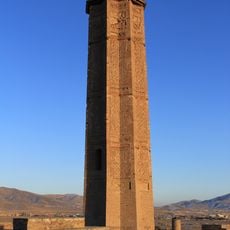
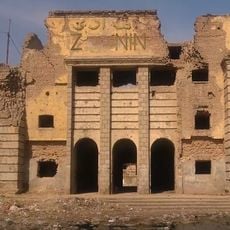
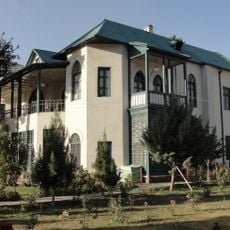
Palace of Sultan Mas'ud III, Royal palace from Ghaznavid period in Ghazni, Afghanistan.
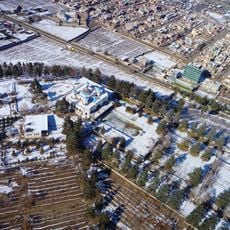
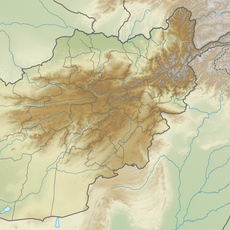
The Palace of Sultan Mas'ud III is a Ghaznavid ruin in the Rauza suburb northeast of Ghazni, Afghanistan. Built in 1112, it was excavated by Italian teams in 1957 and 1958. The remains include a central courtyard, a partially unearthed iwan, and a marble dado whose 44 panels and some 400 fragments were found in place and across the site.
The palace was built in the early 12th century under Sultan Mas'ud III, who ruled the Ghaznavid Empire during its final decades. Not long after his reign, the Ghaznavid dynasty was overtaken by the Ghurids, and the palace gradually fell into ruin.
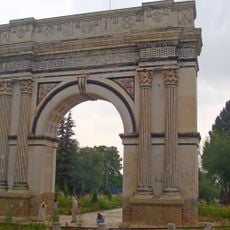
The marble dado carries two separate texts: a poem in Persian written in Kufic script, and a second inscription in Arabic. They are distinct compositions, not an alternation of languages. The sultan's name appears on a marble arch, and the excavated dado panels were divided between Kabul and collections abroad.
The site sits close to the main road between Kabul and Kandahar, making it relatively straightforward to reach even though it lies outside the city center. The ground is uneven in many areas, so sturdy footwear is a good idea before walking through the courtyard and foundation walls.
A marble arch within the complex carries the carved name of the sultan, which is rare among surviving palace structures from this region. Just nearby stands a small cemetery with the domed shrine of Ibrahim of Ghazna, placing a royal and a sacred site side by side within a short walk.
The community of curious travelers
AroundUs brings together thousands of curated places, local tips, and hidden gems, enriched daily by 93,898 contributors worldwide.