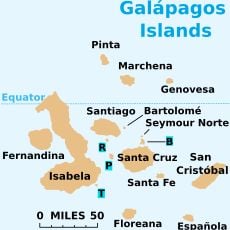
Sierra Negra, Shield volcano on Isabela Island, Galapagos Islands, Ecuador
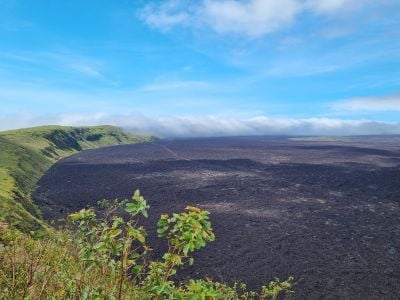
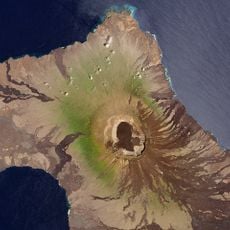
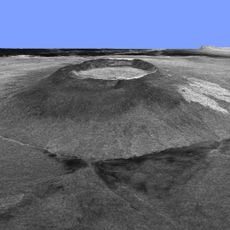
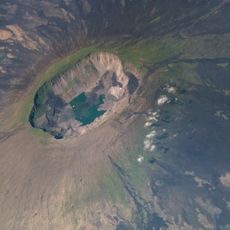
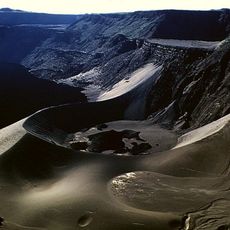
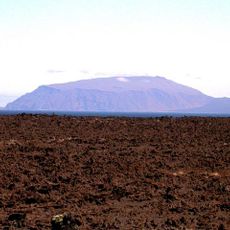
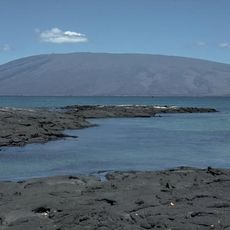
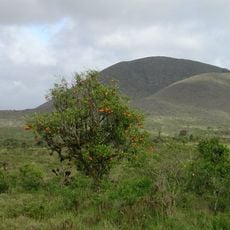
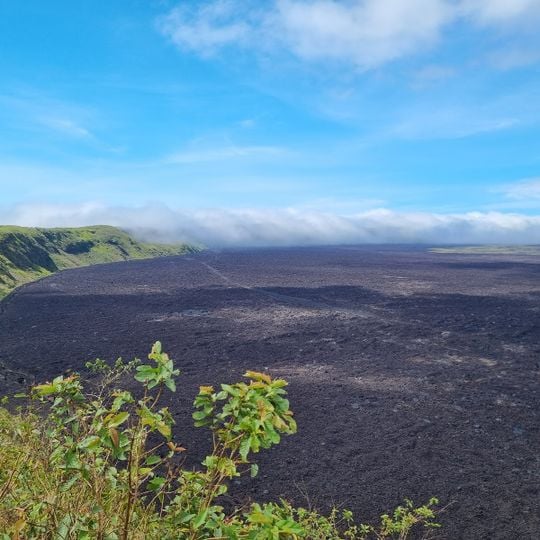
Sierra Negra is a shield volcano on Isabela built from basalt rock, featuring a large sunken crater at its summit. The crater basin is surrounded by dark volcanic slopes that descend gradually, creating a broad depression filled with volcanic rock and sparse vegetation.
Sierra Negra is an estimated 535,000 years old, dated from its volume of 588 km3 and eruption rates. Recorded eruptions occurred in 1911, 1948, 1953, 1954, 1957, 1963, 1979 and 2005, the last producing about 1.5 x 10^8 m3 of lava over nine days. The most recent eruption began on 26 June 2018, ten days after La Cumbre, and was predicted five months in advance by supercomputer models.
The volcano's name means "Black Mountain" in Spanish. Its southern and southeastern slopes are the habitat of the Sierra Negra giant tortoise, Chelonoidis nigra guentheri, which has a saddleback shell and is part of an ecosystem restoration program. The eastern side is partly farmed by residents of Puerto Villamil, the island's main town of about 2,200 people.
Visiting requires a certified guide from Puerto Villamil, and the trails climb gradually around the crater rim. Early morning visits offer better conditions due to cooler temperatures and clearer visibility across the volcanic landscape.
Sierra Negra's caldera is the largest of all Galapagos volcanoes, measuring 7.2 by 9.3 km with its long axis running southwest to northeast. It is also the shallowest on Isabela, only 100 m deep, and holds a 14 km ridge inside it. Between that ridge and the western wall lies Volcan de Azufre, a fumarole field where terrestrial sulfur flows have been identified, linked to melting sulfur deposits.
The community of curious travelers
AroundUs brings together thousands of curated places, local tips, and hidden gems, enriched daily by 94,674 contributors worldwide.