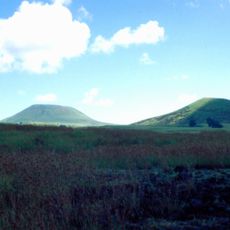
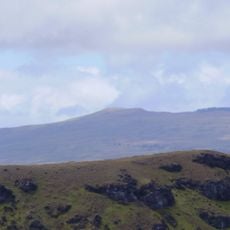
Rano Kau, Shield volcano in Rapa Nui Commune, Chile.
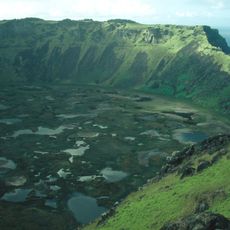
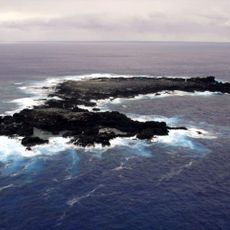
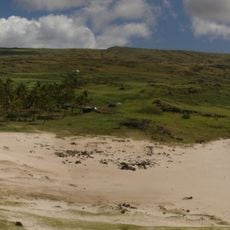
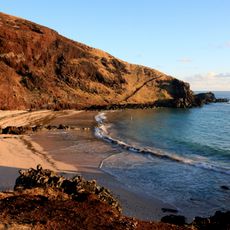
Rano Kau is a 324 m extinct shield volcano forming the southwestern headland of Easter Island. Its crater, almost a mile across, holds one of the island's three natural freshwater lakes, about 100 m above sea level and more than 200 m below the highest ridge. The inner walls slope between 65° near the crest and 45° at the lake shore, and the eroded cone drops to the sea in high cliffs.
The volcanic formation developed during the Pleistocene through basaltic lava flows, with the youngest rocks dating between 150,000 and 210,000 years ago. This ancient geological activity fundamentally shaped the island's landscape.
The ceremonial village of Orongo sits where the crater rim meets the inner wall, filled with petroglyphs and stone structures from earlier times. This location reveals how Rapa Nui people gathered to perform important rituals at this sacred spot.
The crater rim and Orongo are reached from Hanga Roa by road; the northern slope of the volcano descends toward Mataveri International Airport. Paths along the rim are unguarded above the 1.5 km-wide caldera, whose inner walls slope between 45° and 65°. Near Orongo the cliff drops about 300 m to the sea at an angle of 50°.
The last wild toromiro tree grew on the inner crater slope until it was cut for firewood in 1960. The crater also supplied obsidian for the island's stoneworkers, and in the early 20th century the island manager photographed steam rising from the crater wall.
The community of curious travelers
AroundUs brings together thousands of curated places, local tips, and hidden gems, enriched daily by 94,020 contributors worldwide.