Tahai, Archaeological site in Rapa Nui, Chile
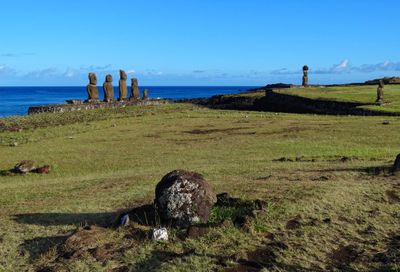
Tahai is a ceremonial complex of three ahu on the coast north of Hanga Hoa, covering about 250 m². From north to south they are Ko Te Riku, Tahai and Vai Ure. Ko Te Riku carries a single moai with eyes of white coral and a reddish-brown pukao of volcanic rock on its head; Ahu Tahai's lone moai stands 4.5 m tall. The site also holds the ruins of a village of hare moa and a stone ramp to the sea.
The site was settled around the 8th century and served as a major religious and political center for the early island community. The platforms were built and modified over many generations, showing how construction practices changed over time.
The three platforms carry Rapanui names: Ko Te Riku, Tahai and Vai Ure. Tahai means "where the sun hides" and Vai Ure "dark water". The complex is still used for contemporary ceremonies, including the coronation of the Tapati festival, and the graves of archaeologists William and Emily Mulloy lie on the site.
The site sits just outside the village of Hanga Roa and is easy to reach on foot, with national park entry required. The ground is flat and open with little shade, so bring sun protection and water for your visit.
One of the moai statues here has been given restored eyes made from modern material, showing what these figures originally looked like when new. This is the only statue on the island that has been restored in this way.
The community of curious travelers
AroundUs brings together thousands of curated places, local tips, and hidden gems, enriched daily by 93,864 contributors worldwide.