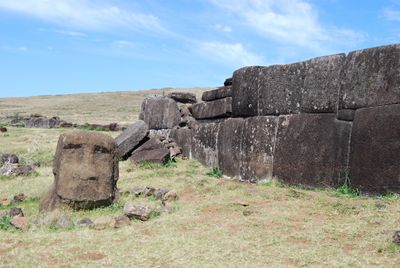
Ahu Vinapu, Archaeological site on the southeastern coast of Easter Island, Chile
Ahu Vinapu is an archaeological site on the southeastern coast of Rapa Nui whose ceremonial center comprises three ahu: Vinapu I, Vinapu II and Vinapu III. Its platform is built of large, carefully fitted basalt slabs, with two courses of dark grey and brownish blocks whose rough, weathered faces carry lighter patches; in places blocks have collapsed and one leans diagonally against the standing wall.
Vinapu comprises three ahu, Vinapu I, II and III, on the south coast. The Peruvian historian José Antonio del Busto and Jean Hervé Daude argued, from 16th-century Spanish chronicles such as Pedro Sarmiento's, that the Inca Túpac Yupanqui had Ahu Vinapu built during a Pacific expedition in 1465. The American archaeologist William Mulloy investigated the site in 1958.
The name Vinapu has no translation in the Rapanui language. The ceremonial center comprises three ahu: Vinapu I, Vinapu II and Vinapu III. Peruvian historian José Antonio del Busto and Jean Hervé Daude argued, from 16th-century Spanish chronicles such as Pedro Sarmiento's, that the ahu was built by the Inca Túpac Yupanqui during his Pacific expedition in 1465.
Ahu Vinapu lies on the south coast, reached by the coastal road east of Hanga Roa; the site is part of Rapa Nui National Park, entered with the park ticket. The ground around the platforms is dry grass and bare earth, with loose stones near the collapsed section, so watch your footing. The wall faces the sunrise at the winter solstice, best seen early in the morning.
The stone wall faces directly toward the winter solstice sunrise, revealing the astronomical knowledge of the ancient builders. This precise alignment shows they understood the heavens well enough to orient their sacred structures accordingly.
The community of curious travelers
AroundUs brings together thousands of curated places, local tips, and hidden gems, enriched daily by 92,711 contributors worldwide.