Huaca del Dragón, Archaeological pyramid in La Esperanza, Peru.
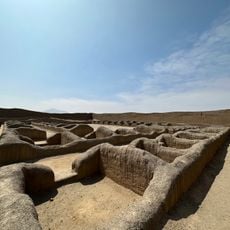
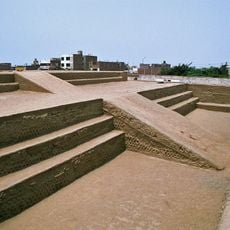
Huaca del Dragón is a Chimú adobe monument in La Esperanza, near Trujillo, made of tan mud walls. A main ramp slopes up beside solid vertical walls, and a taller wall segment to the right carries raised rectangular reliefs in vertical rows. Lower flat-topped walls extend to the left across gravel ground.
Built in the Early Chimú period, around the 11th century AD, the huaca was a religious, ceremonial and administrative centre of adobe. Its square-ended adobe bricks and mixed modelling and carving of the clay friezes rule out the earlier Moche or Middle Horizon attribution. In the colonial era it was looted by treasure hunters; Richard Schaedel excavated it in 1948–1950 and Francisco Iriarte Brenner restored its walls in the 1960s.
The reliefs depict a stylized two-headed rainbow whose heads appear to swallow a central figure, with feline-dragon figures with open jaws in the middle section. A two-headed being on a small altar holds a tumi knife between its jaws, a symbol tied to sacrifice and sacred power. The decoration uses only ochre and white, unlike neighbouring huacas with up to five colours.
The site is accessible daily and requires an entry ticket that also grants access to Chan Chan and Huaca Esmeralda nearby. It helps to arrive early in the morning when it is cooler and less crowded.
In 1966 the archaeologist Richard Schaedel recorded that locals also called the monument "Huaca Ciempiés" (Centipede Huaca), because the repeating, wavy carved bodies on the perimeter walls looked like a centipede. The name survives in his field notes rather than on any sign at the site.
The community of curious travelers
AroundUs brings together thousands of curated places, local tips, and hidden gems, enriched daily by 92,787 contributors worldwide.